The Art of Curating an Art Exhibit
Written by Ian McKechnie
Not long ago, my colleague Ruth Kelly-Koebel oversaw the installation of an exhibit at Kindred Coffee Bar, a short walk from the Kawartha Art Gallery. This exhibit, which is titled Authenticity, is a collection of artworks prepared by the talented students enrolled in I.E. Weldon Secondary School’s International Baccalaureate (IB) visual arts programme.
Hanging an exhibit of this kind in an unconventional space (a coffee shop) and utilizing QR codes in place of old-fashioned object labels demonstrates just how far we have come in terms of making art accessible to a wider audience. Similar initiatives have also been embraced at art galleries and museums in other parts of the province, country, and wider world.
But of course things were much different half a century ago, when The Lindsay Gallery was in its infancy and a largely volunteer-run organization had to work within the confines of a limited space – not to mention limited budgets that periodically presented challenges for the Gallery.
So what was it like to curate and hang a show during the first 20 or so years of the Gallery’s existence, when it was housed across two spaces, each with their own challenges?
Those who numbered among the 400 or so individuals crossing the threshold of the Gallery’s original digs at 8 Victoria Avenue North when it opened in the early spring of 1976 were treated to a very eclectic mix of art – as well as craftwork. Howard Partnoy, writing about the occasion for the Peterborough Examiner, described the scene thusly: “Not only paintings were on display, as pen and ink drawings, sculptures, enamelling, hand weaving, pottery and macrame adorned the walls of the five display rooms.” According to Partnoy’s article, some 57 pieces of art were on display throughout the Gallery, with more pieces available for sale in its modest gift shop.
It was a lot of stuff in a comparatively small space – but this inaugural exhibit, focused as it was on the work of the Kawartha Arts and Crafts Association, stirred up excitement and interest. Another nine exhibits would follow in 1976 alone, each highlighting the talents of [mostly] Gallery members. These included a selection of recent paintings by Pamela Lager, the works of Charles Brett, and a smattering of drawings and paintings by George Kovacs.
Curatorial tasks at this time were shared among a dedicated group of volunteers. Minutes of the Gallery Committee, dated November 30, 1976, offer a window into who was responsible for overseeing exhibits during that first year of operation. An Exhibition Supervisor, in the person of Sandra Ackert, was entrusted with looking after all shows, acquiring and caring for artworks, as well as setting up and dismantling exhibitions. Ms. Ackert was ably assisted in these tasks by Fran DiActis and George Kovacs. David Baker, meanwhile, was assigned the role of curator, and it was his job – assisted by Ed Warner – to “oversee repairs and maintenance and installation of new equipment.” Mr. Baker was also tasked with the “transporting of articles donated to the gallery.” (In 1976, then, “curator” was apparently synonymous with “custodian.”)
These roles were soon amalgamated into a position known as the Director. Discussions in 1978 culminated in the hiring of Michael Burtch as the Gallery’s first professional director, who set about the task of scheduling a rotation of exhibitions. In a working paper presented to The Lindsay Gallery’s board of Governors on August 8, 1978, Burtch noted the following:
Among the priorities is the need to finalize an exhibit schedule for the upcoming year. I have prepared a conditional schedule…The concept which motivates the schedule is one which will provide Lindsay and district with as broad a scope of art as possible; contemporary, and historical, regional and national, abstract and representational, and works in varying media…The schedule is also geared to generate local interest by presenting exhibitions that utilize both local talent and local themes…Budget estimate forms have been prepared and will be used in determining projected costs of exhibitions in advance of our fundraising efforts.
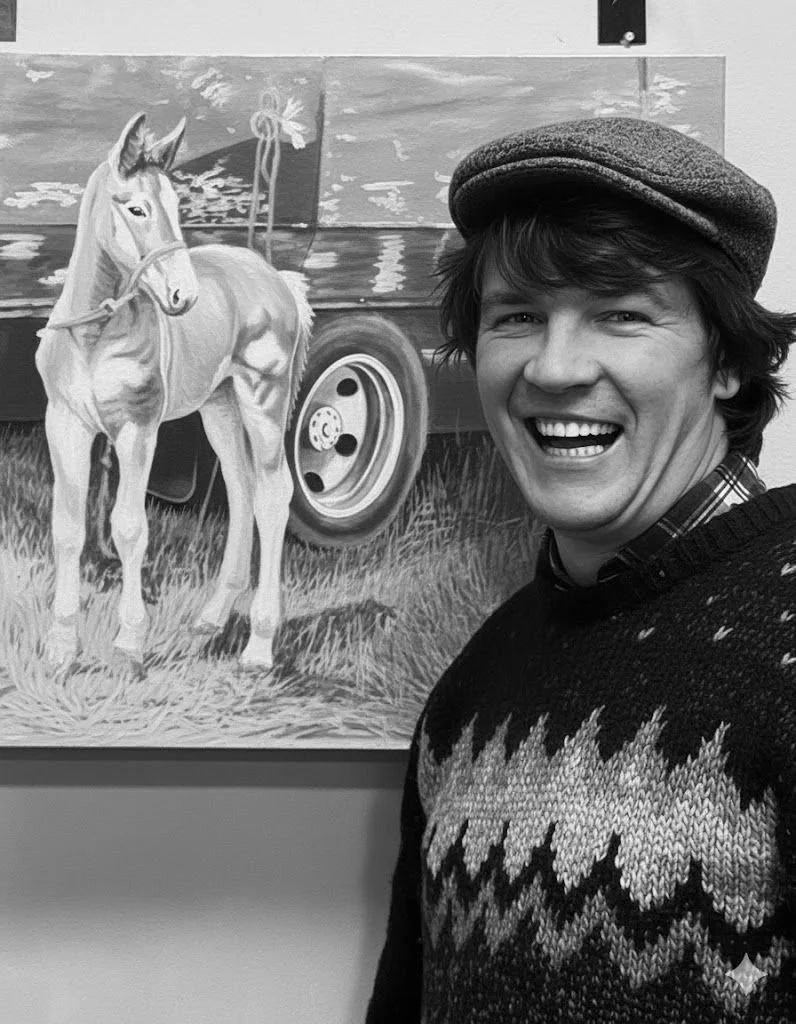
Chuck Burns
Chuck Burns, four directors removed from Mr. Burtch, followed much the same philosophy. When he was appointed to the role in 1992, the Gallery had been operating in two locations for close to 15 years. The original venue at 8 Victoria Avenue North would soon close and operations would be consolidated into the Ethel Flavelle Gallery on the second floor of the Lindsay Public Library’s 1977 addition. In the early 1990s, though, what was affectionately known as “Studio 8” was still serving its adopted purpose as a community art gallery.
Chuck recently sat down with me to share his recollections of curating exhibits in that space. He began by reminding me that exhibitions had to be planned upwards of two years ahead of time, and while locally developed shows remained a priority, hosting shows curated by and at other art galleries assumed added importance. “This gave you more bang for your buck,” Chuck says. The success of these depended on his leveraging connections within the tight-knit visual arts community – particularly the watercolourist community – to determine what sorts of shows were available for loan and exhibition at The Lindsay Gallery. “All of the directors and curators [in the gallery sector] know each other,” he adds.
Public education was also a priority at this time. Chuck points out that a curator must be able to listen to, as well as lead, an audience. To illustrate his point, he tells a story of working at the Art Gallery of Algoma in the 1970s, when 25 to 30 local artists were taken through the Algoma steel mill. Invitations to exhibit openings went out with pay stubs issued to steel mill workers, thereby reaching an audience that might not normally have visited an art gallery. Chuck also recalls curating exhibits at the Algoma Art Gallery geared towards the local sporting community. “You have to put stuff in front of people that they’re interested in – and then introduce them to more,” he remarks.
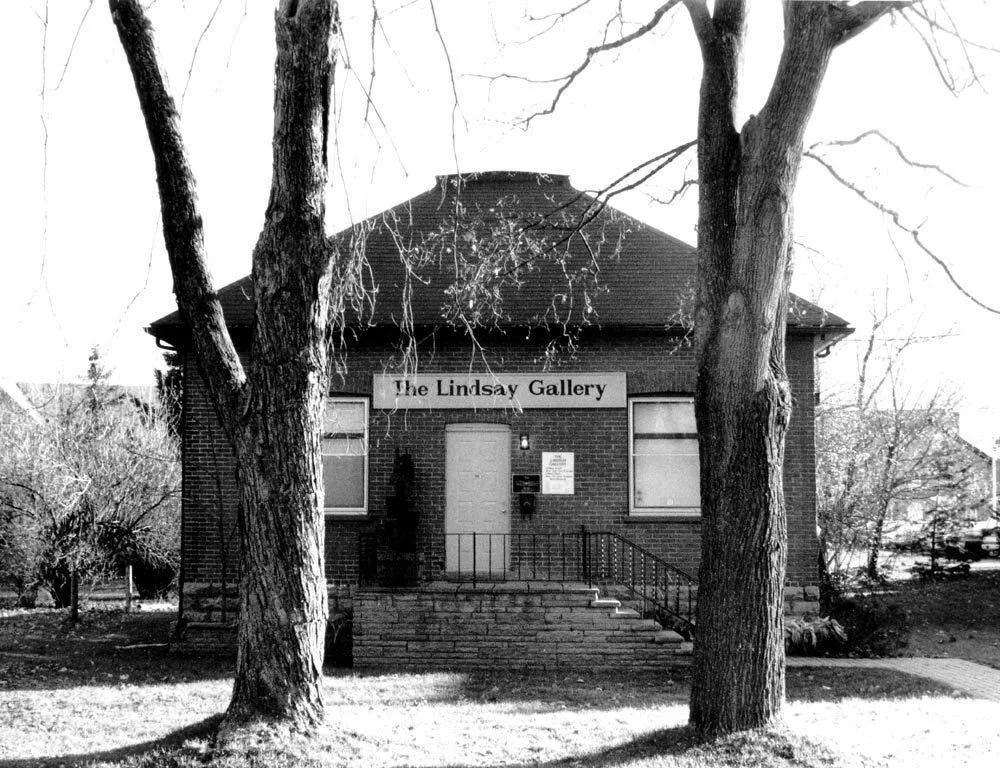
Studio 8
Chuck brought these lessons to Lindsay and set about curating a variety of shows in the unique confines of Studio 8 – which was expressly not designed as an art gallery. A large room at the front of the building was set aside for major shows, but it also functioned as a gateway to a smaller space at the back, where works by local and regional artists were mounted. As such, the number of shows doubled yearly, with 12 major exhibitions out front and 12 regional or local shows out back. Many of these focused on a particular theme; Chuck remembers a show that was curated in honour of International Women’s Day, for instance.
Working with student employees hired under Ontario Arts Council grants, Chuck and his team ensured that the art of curating an art exhibit was kept alive and well during a time of transition for The Lindsay Gallery. The tools we use to curate exhibits may evolve, and the spaces in which we curate them may differ, but the question Chuck asks as we wrap up remains much the same now as it did 35 to 50 years ago: “How can we grab people’s attention when they first come in?”

Every month, join Research Associate Ian McKechnie as he opens the doors to Kawartha Art Gallery’s archives, sharing the remarkable history and the dedicated individuals who made the City of Kawartha Lakes only public Art Gallery with a Permanent Collection a reality.