Written by Ian McKechnie
As I write this, the Kawartha Art Gallery is only a few weeks away from moving down the street and around the corner into its new quarters at 19 Cambridge Street South. For the first time in close to 50 years, the Gallery won’t have a presence on the second floor of the Kawartha Lakes Public Library’s Lindsay branch. It is indeed the end of an era.
The origins of the Gallery’s relationship with the library can be traced back to well before the former’s founding in 1976. By the middle 1960s, the Lindsay Public Library was outgrowing its facilities constructed in 1904 under the auspices of a grant from Andrew Carnegie, the Scottish-American steel magnate. Similar libraries were built across Canada and the United States at the turn of the 20th century; as library collections expanded and the populations of towns and cities grew, these buildings became cramped.
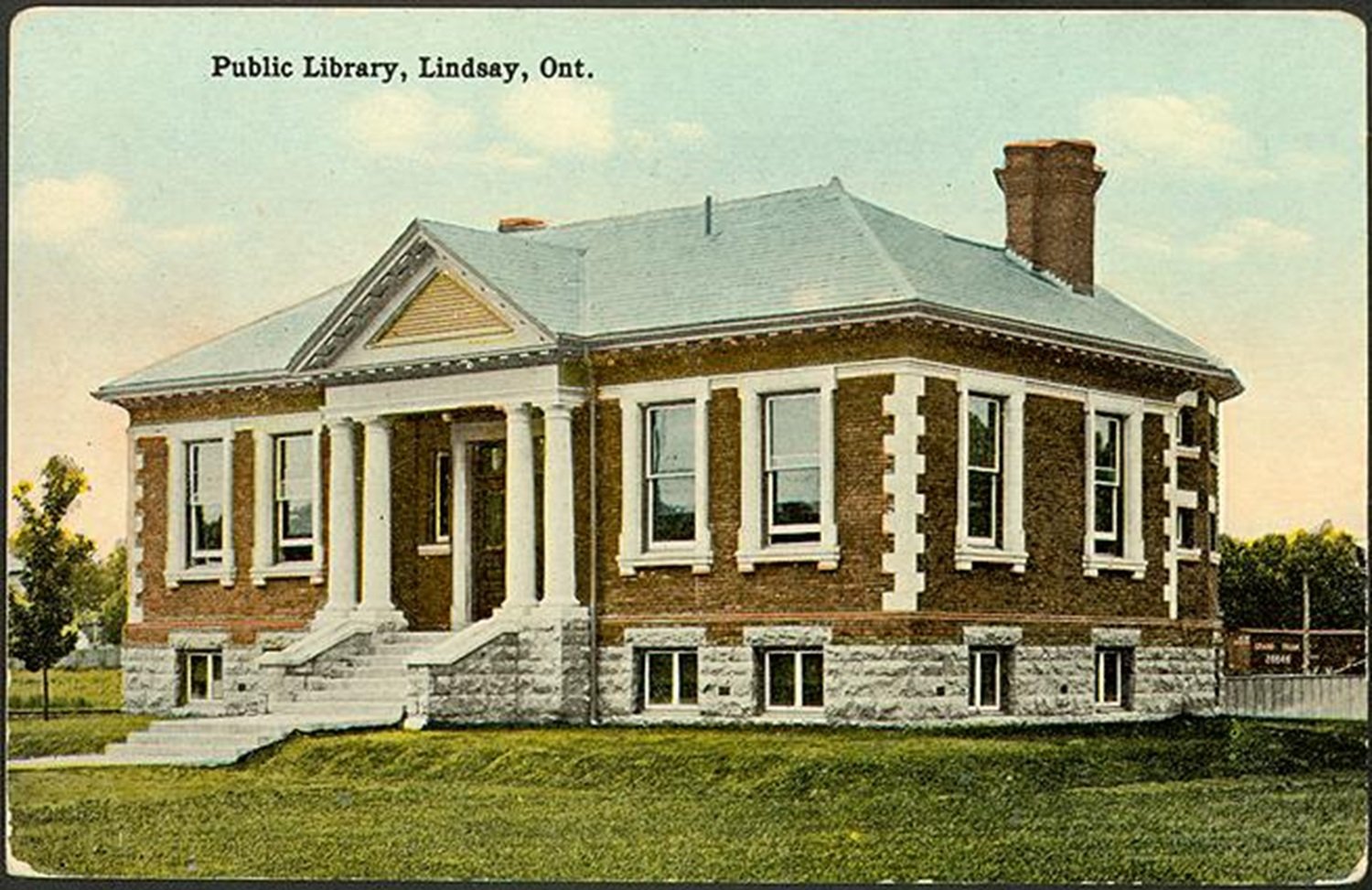
The Lindsay Public Library’s Carnegie building as it appeared in 1910. Toronto Public Library Collection, Public Domain.
An addition to the original building was fast becoming a necessity. And not only for a public library, but a gallery, too. Throughout the 1960s, pieces of art were being donated to the Lindsay Public Library for display. Others were being acquired by the Lindsay Art Guild (one of the Kawartha Art Gallery’s predecessor organizations), but it lacked an appropriate venue in which to exhibit these artworks. It was perhaps inevitable, then, that public gallery space would figure into plans for a public library expansion.
Following a tendering process, Michael J. Torsney (1930-2023), a young Irish-born architect who maintained a practice in the Hamilton area, was approached to design a bold new addition for the library. (According to a 2019 interview with the late Moti Tahiliani, who served as chief librarian from 1967 through 1997, Torsney’s design was so well-engineered that it would have been capable of supporting two more storeys on top of the present structure.)
Project financing had to be approved and signed off on by the Ontario Municipal Board by a certain date, lest the tendered bids expire and the process go back to the proverbial square one. Unfortunately, this is exactly what happened. Once it was finally approved, recalled the late Connie Blasco in a letter to then-Mayor Jim Flynn in 1985, “the contractor wouldn’t hold to the initially tendered price and Council wouldn’t go for another $30,000.00.” The project was shelved and Mr. Torsney’s plans were put away for several years.
Put away – but apparently not forgotten.
That’s when Margot Fawcett – and Wintario – helped change the course of history for both the Lindsay Public Library and The Lindsay Gallery. A popular lottery game developed in 1975 by the Ontario Lottery Corporation, Wintario generated funds that were then allocated for community-building capital projects. An enthusiastic mover and shaker from almost the time she and her husband moved to Lindsay in 1962, Margot was well-suited to the task of being an advocate for civic projects in town. She had worked in the Toronto publishing industry for several years and had established connections in the city that would prove beneficial to her adopted home community. “I heard about Wintario grants in Toronto, and one was for libraries,” Margot recalls. The stars were aligning nicely.
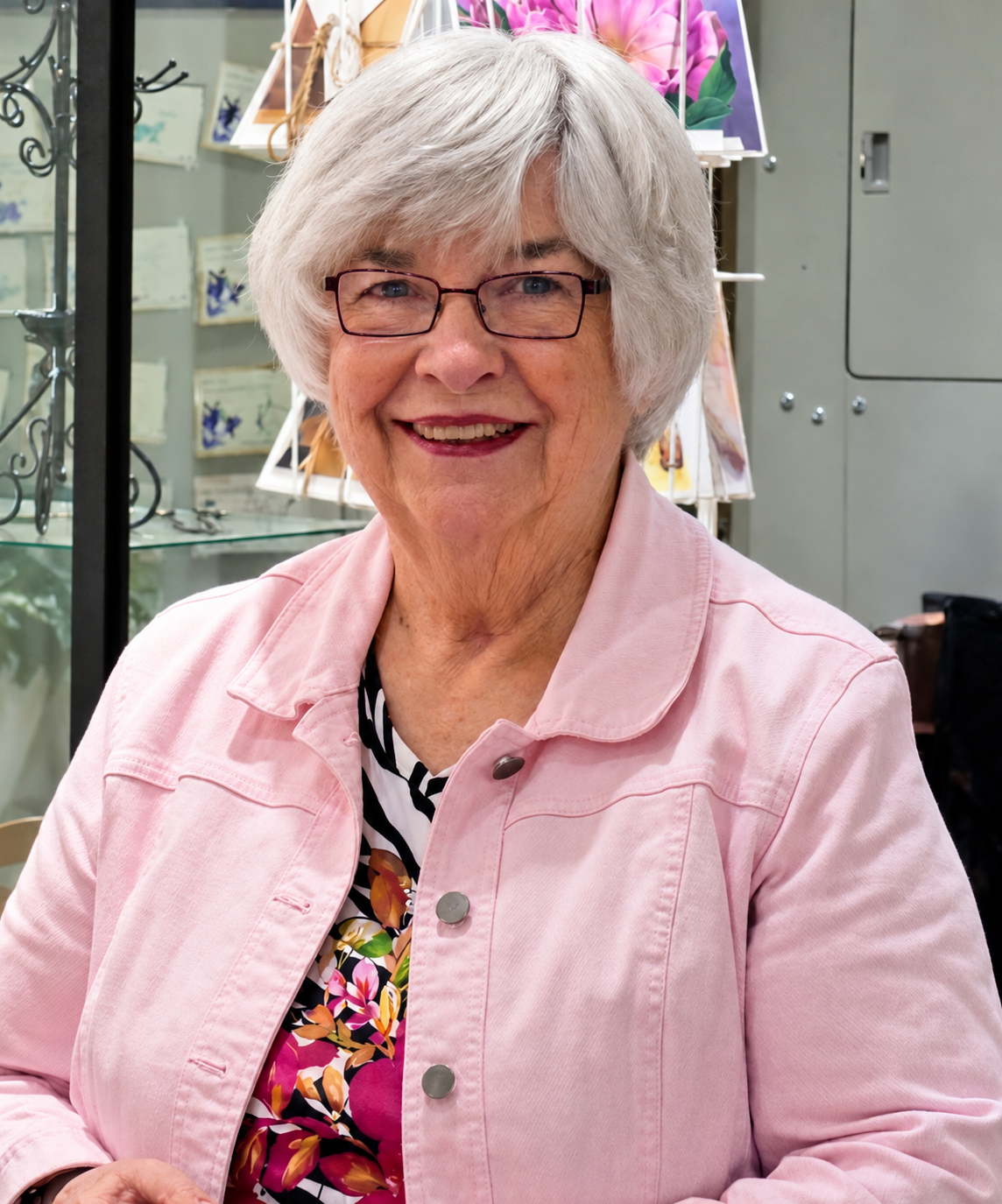
Margot Fawcett, who spearheaded the process of securing Wintario funding for a public library expansion.
Because libraries overseen by library boards – such as that in Lindsay – were included in the list of eligible organizations, the Lindsay Public Library Board jumped on the opportunity to apply for a Wintario grant, Margot says. “The Library Board had already made the decision to encourage the town council to build an addition, and the board did not hesitate to promise in their Wintario application to organize a fundraising campaign to raise the matching funds if their Wintario project application was approved.”
Wheels began to turn and excitement grew. “As our Wintario application project, the Library Board submitted the shelved architectural plans for a two-storey library addition with an art gallery on the second floor, which had been approved several years previously by the town council when Bert Hick was mayor,” Margot remembers. “It was that town council who had determined that Lindsay would have a public art gallery on the second floor.”
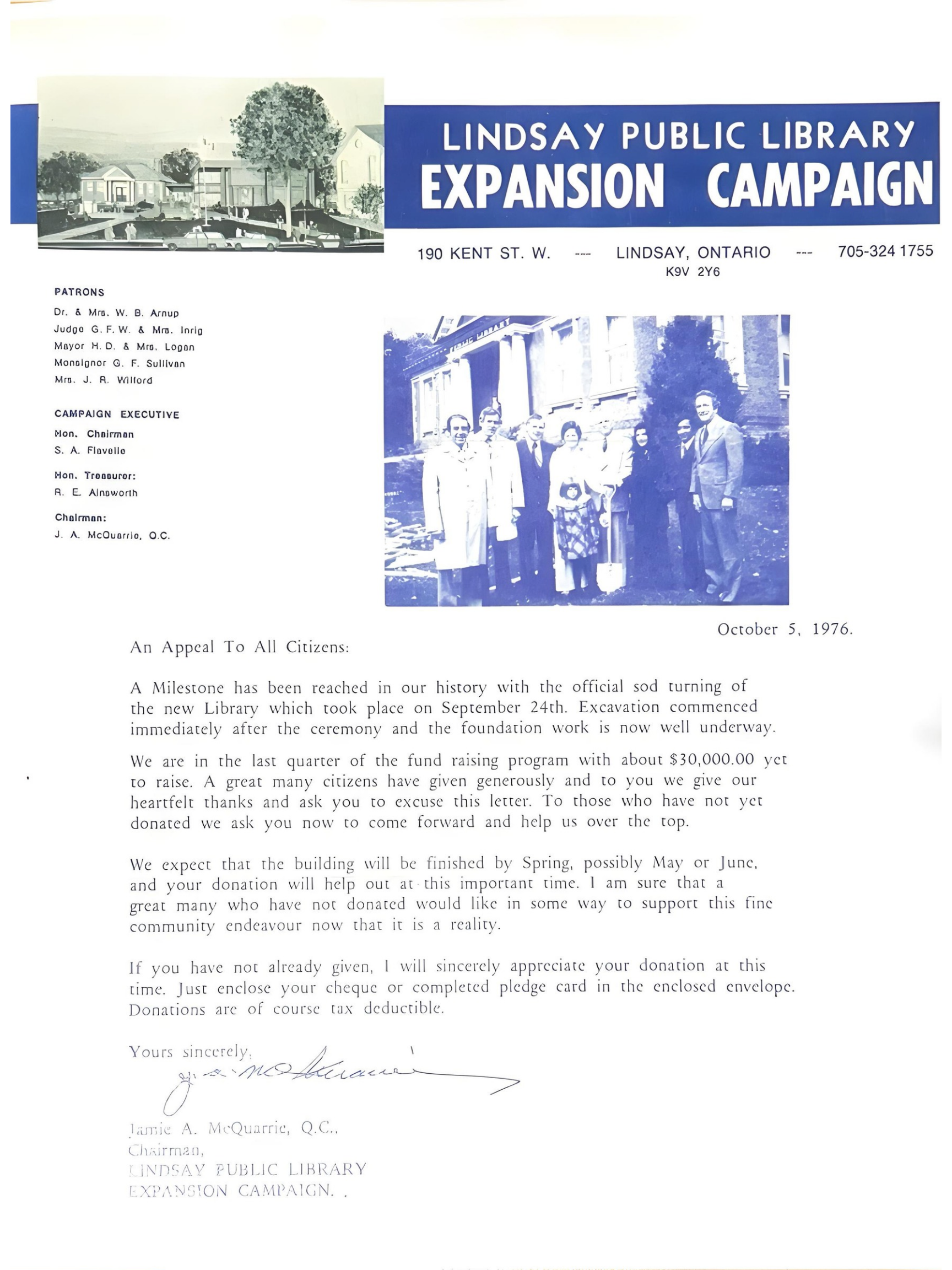
This letter was circulated to local citizens in October 1976, during the last quarter of the fundraising campaign for the Lindsay Public Library expansion.
The application itself was signed by Mayor David Logan on Margot’s dining room table, and the new library addition was officially opened for use on September 16, 1977.
During this period, incidentally, Joyce Enslin and others were laying the groundwork for what was officially incorporated as The Lindsay Gallery Inc., and known colloquially as “Studio 8.” Talk of an art gallery operating out of the second floor of the Lindsay Public Library was naturally concerning to those trying to get things off the ground a short distance away at the little red brick house-turned-art gallery on Victoria Avenue North. They had, after all, successfully applied to the provincial government for recognition as a public art gallery – and they had a full slate of exhibitions planned for the coming year.
Would the fancy new gallery under construction in the library – to be known as the Ethel Flavelle Gallery, in honour of a longtime secretary of the library board – prove to be competition? “Feelings were running very high,” Margot says of this time, and in due course a joint committee was set up to facilitate conversations and negotiations between The Lindsay Gallery and the Lindsay Public Library Board. A December 13, 1977, letter from Margot to Pamela Lager, chair of The Lindsay Gallery Inc. board, spells out its purpose:
“The delegates will recommend to their respective Board whether or not the community would be better served if the two galleries continue to be operated separately or, in future, jointly through the formation of an umbrella board.”
That “umbrella board” was to be known by the rather cumbersome name of “the Administration of The Ethel Flavelle Gallery by the Coordinating Committee of the Lindsay Gallery Inc.,” and was given the somewhat confusing acronym, COAG. Pamela Lager, David R. Walling, and Lois Smith would represent the Gallery, while Connie Blasco and Margot Fawcett would represent the Lindsay Public Library in the negotiations. Draft terms of reference spell out responsibilities to be shared between the Gallery and the Library across three main areas: funding and cost allocations, staffing, and security. After several months, an agreement was reached, and from then on, the Ethel Flavelle Gallery would be administered by The Lindsay Gallery Inc. board, via a lease agreement.
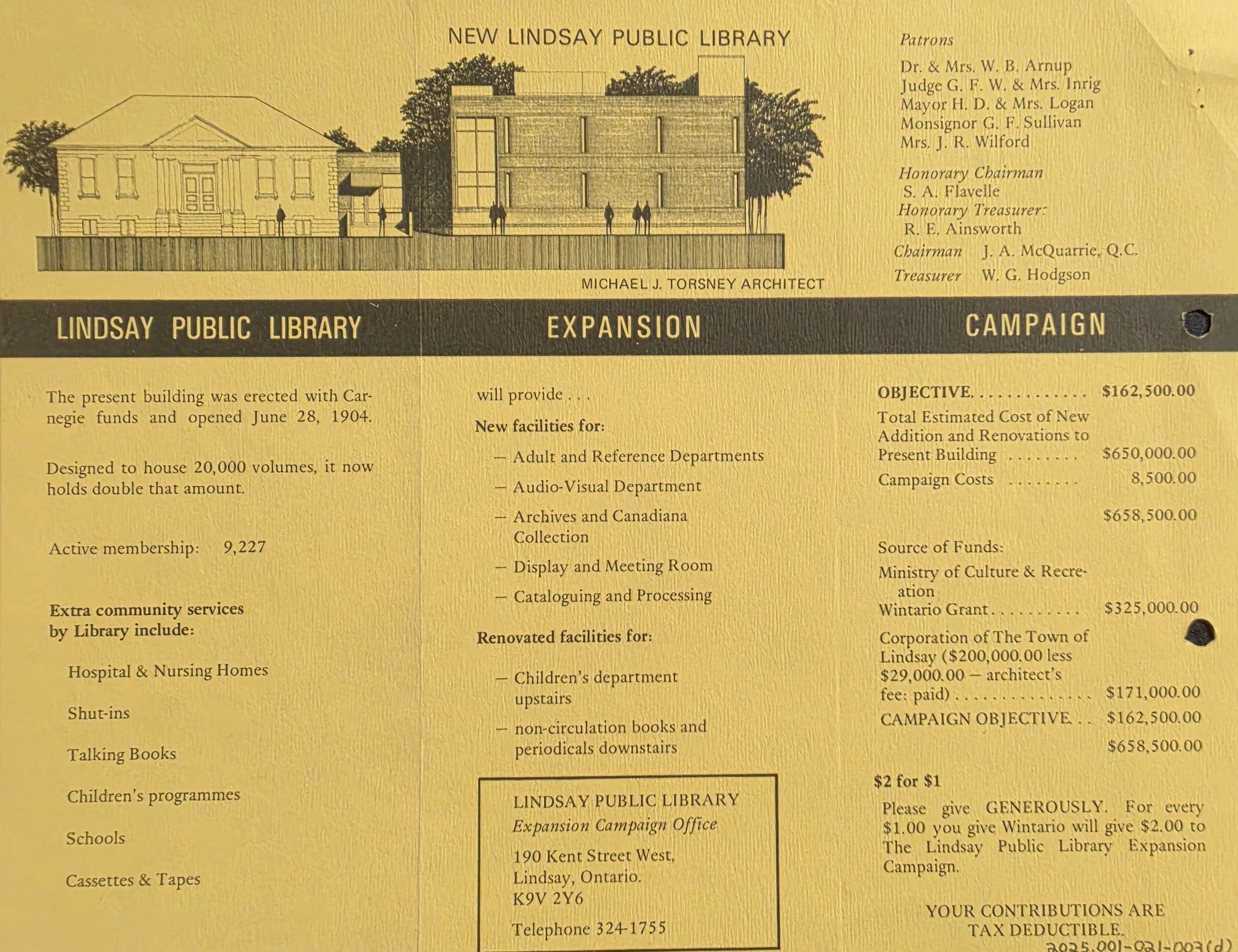
This brochure tantalized Lindsay’s citizens with details about the new public library expansion in 1976. Oddly, it makes no mention of the art gallery planned for the top floor.
There the story ended. Or did it? By the mid-1980s, the relationship between the Lindsay Public Library and The Lindsay Gallery was once more up for discussion.
Minutes of the Board of Governors of The Lindsay Art Gallery, dated December 8, 1983, indicate that the ideal solution would see operations of Studio 8 amalgamate with those of the Ethel Flavelle Gallery: “The general consensus of the Board of Governors was that it would be much better to be under one roof. Consolidating would be better in light of government cutbacks. Moved by David [Walling] that the Board advise the Library Board that we are interested in renting the basement space and the Ethel Flavelle Gallery space for a net sum of $4500 per annum, for a minimum of two years.”
Others, however, maintained that the Gallery’s tenancy on the second floor of the public library was only temporary – a kind of holding pattern until a suitable new home could be found. That was the conclusion reached by local lawyer and former Library Board member, Jim McQuarrie (1925-1988), whose opinion was sought by Rod Ainsworth, chair of the Gallery board. In a letter dated August 14, 1984, McQuarrie wrote as follows:
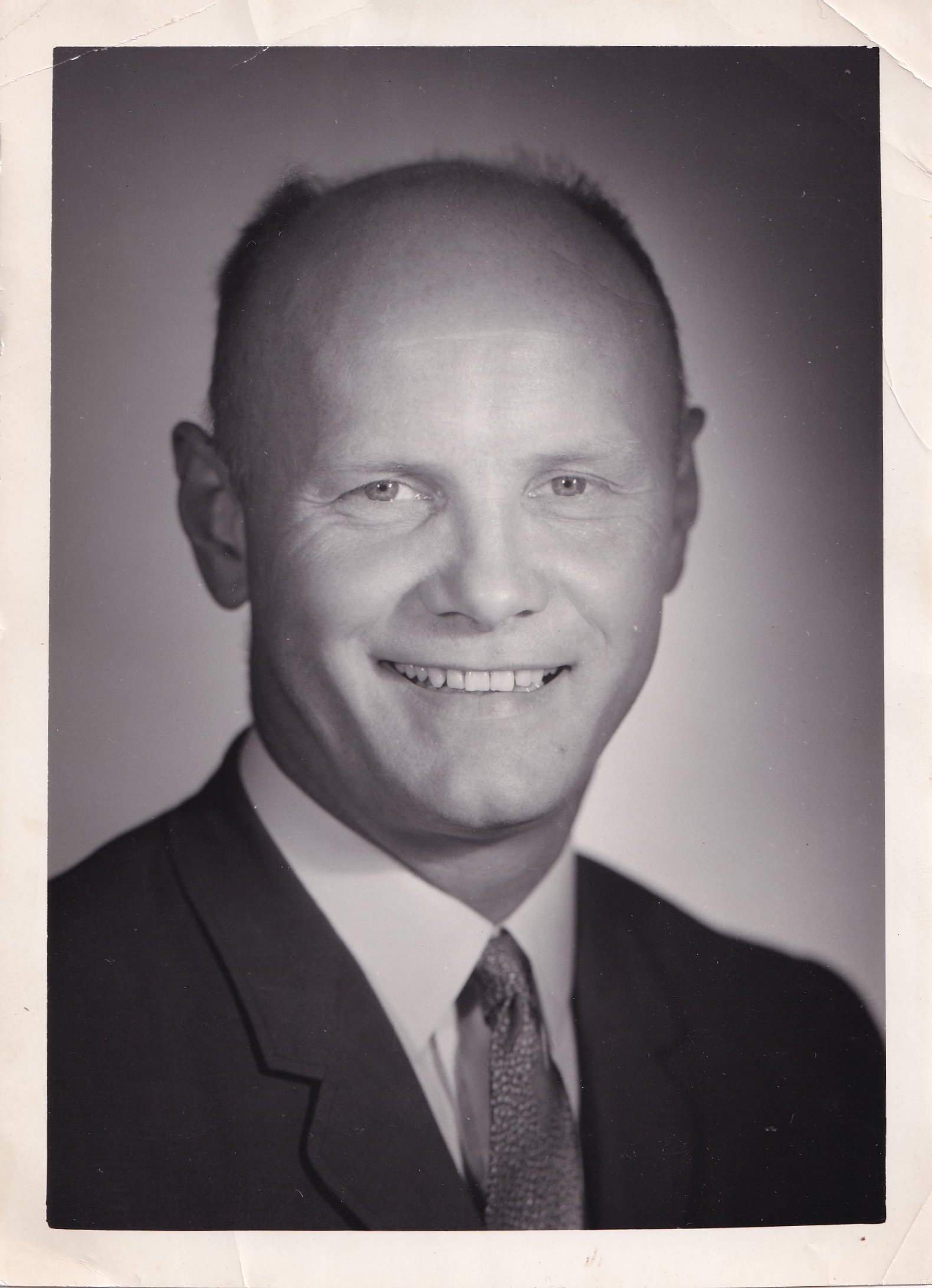
Jim McQuarrie, who served as chairman of the 1976 Lindsay Public Library expansion fundraising campaign, and later served on the public library board from 1978-1983.
“It is obvious from the material that the intention was to include the Art Gallery on the third floor of the new building and this is pretty consistently shown in all of the material. The question which is unanswered is that of the tenure of the Gallery. Was it intended to be of a permanent kind or was it intended to be temporary?...I think we are all of the impression that the building was, in fact, constructed as a library and that at some future time, the area which the Art Gallery would occupy would be used for library expansion. There is just no time span mentioned and nothing to tie down when that expansion might commence. I suppose the inevitable has happened and the library now wishes to expand.”
“Not having been involved in any policy discussions which may have taken place in 1976 and the years previous, I can only give you my own impression which indeed is just that – and that is that the building would some day be used for the Library and that the Art Gallery would, in its own time, develop a home of its own.”
McQuarrie’s conclusion seems to be at odds with the intentions of those who prepared the Wintario application almost a decade before. The second – or third, if one counts the basement – floor of the library expansion (for which McQuarrie, ironically, served as fundraising campaign chairman) was always meant to be used as a gallery space.
Apparently, though, The Lindsay Gallery shared at least some of McQuarrie’s conclusions, for by the spring of 1985, the Gallery was on the verge of leaving the library entirely.
Extensive correspondence preserved in the Kawartha Art Gallery archives makes it clear that a combination of rental increases, being charged for the use of library facilities (such as the downstairs auditorium for board meetings), and too many shows being held across two venues had prompted the Gallery board to take action. A July 12, 1985, letter from President Sandra Ackert to members and volunteers offers this announcement:
“Recently, a decision was made by the Board of Governors to terminate our tenancy with the Library as of the 1st of August 1985. This action was taken to enable the Gallery to consolidate its energies, resources and its ability to offer a greater variety of programs under one roof. We believe that our new facility at Studio 8 will better serve the community, the members and the volunteers who have supported the Gallery over the years.”
Eventually, the winds shifted and The Lindsay Gallery ultimately decided to remain in the Ethel Flavelle Gallery space for the foreseeable future. It would go on to be the venue of choice for several shows and exhibit receptions during the second half of the 1980s; when Studio 8 was forced to close in 1994 as a result of a new police station being built, the second floor of the Lindsay Public Library became the de facto headquarters of The Lindsay Gallery.
Jim McQuarrie’s letter would prove to be prophetic, however. In due time the public library’s reference services department would expand into approximately half of what was originally the Ethel Flavelle Gallery, resulting in the truncated art gallery space that has served the community continuously for the past almost 30 years. A semi-permanent folding wall separates the two spaces, and library staff share the adjacent kitchen with Gallery staff.
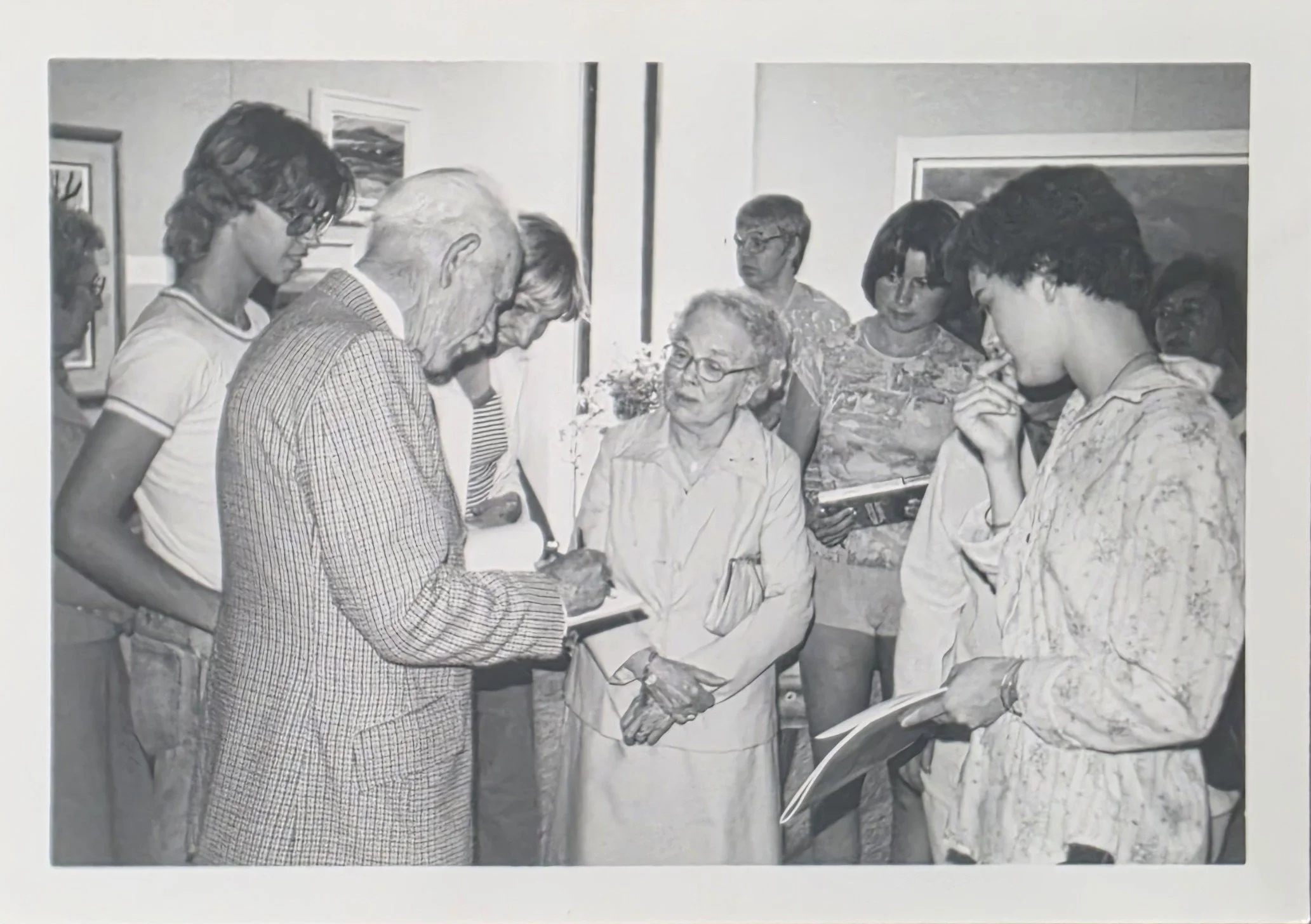
A.J. Casson, the last living member of the Group of Seven, pays a visit to the Ethel Flavelle Gallery in June of 1979.
In a few weeks’ time, the Ethel Flavelle Gallery will be a gallery no more. It is a bittersweet moment in the 50-year history of the Kawartha Art Gallery. For it was to this space that A.J. Casson paid a visit in 1979, boosting morale for the fledgling Lindsay Gallery. It was in this space that some of the Gallery’s most popular shows went up during the bustling years of Rod Malham’s directorship. It was in this space that board members, staff, and volunteers dreamed and worried about the future of the Gallery. It was in this space that aspiring young artists might have had their work mounted for the first time.
Half a century has passed since it was determined that Lindsay would have an art gallery of one sort or another on the second floor of the public library. It’s a story that – like the overarching story of the Gallery itself – has taken many complicated and intriguing twists and turns over the years. But it’s a story that remains forever etched into our history as we move forward as a gallery committed to cultivating the art in everyone.
Every month, join Research Associate Ian McKechnie as he opens the doors to Kawartha Art Gallery’s archives, sharing the remarkable history and the dedicated individuals who made the City of Kawartha Lakes only public Art Gallery with a Permanent Collection a reality.