Catching up with Maureen Bell
Written by Ian McKechnie
The Gallery’s third director recalls her time at the helm
1981 saw the Canadarm installed on the International Space Station, gas stations switch from imperial to metric measurements, and the legacy of Terry Fox live on through a run organized in his honour. Locally, the Town of Lindsay was gearing up for its 125th anniversary the following year, the railway line running along the middle of Victoria Avenue was abandoned after more than a century of use, and The Lindsay Gallery hired Maureen Bell as its third director.
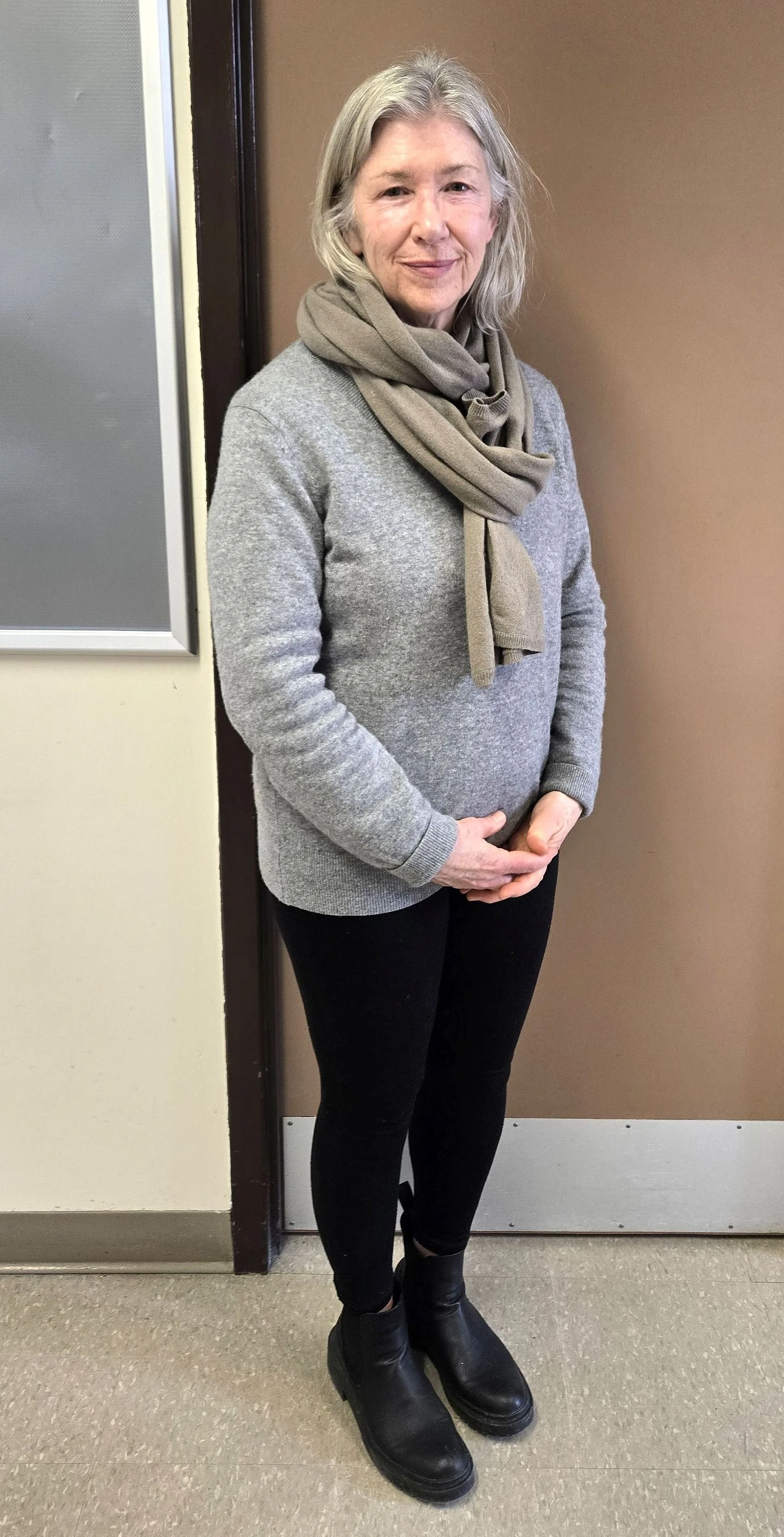
More than 40 years after she left her position to become a teacher, Maureen sat down with me to reminisce about her nearly three years on the job, and reflect on the challenges and joys involved in running the Gallery – then only five years into its existence.
“I was at the McMichael Canadian Collection for four years, working in their education department,” Maureen says of her foray into the world of public art galleries, and of how she came to be hired at the burgeoning gallery in Lindsay. “My husband took a job at Fleming College, and he noticed an ad for a director-curator for The Lindsay Gallery,” she recalls. The couple relocated from Huttonville, Ontario, to Woodville in the early autumn of 1981.
Maureen was only 25 at the time of her appointment, and while she had done an undergraduate degree with a focus in Indigenous Studies at Trent University – something she credits for leading her to work at the McMichael gallery – being thrust into an administrative role was new territory. “Not having a curatorial background, I had to learn all about grants and be introduced to grassroots artists,” Maureen says. “I ended up seeking out other directors [for advice],” she continues, and remembers being introduced to the director of an art gallery in Cobourg as she sought to familiarize herself with central Ontario’s network of gallery personnel.
Maureen also credits Sandra Ackert, one of the Gallery’s founding members, with showing her the ropes – along with outgoing director Michael Burtch, who by then had already left town for a position in Sault Ste. Marie. (The Lindsay Gallery at this time was struggling to find someone who could fill Mr. Burtch’s shoes, and in May of 1981 it hired a director who stepped down very shortly thereafter.) Over the course of many a telephone conversation, Michael Burtch helped Maureen ease into her role. “He really took it from being a gallery that was run by volunteers and put it on the map,” says Maureen of her predecessor.
Although the Gallery was, via the hiring of people like Michael Burtch and Maureen Bell, seeking to become a professional operation, it still relied on a dedicated corps of volunteers in its day-to-day functioning. Maureen speaks warmly of the 30 to 40 volunteers, including such people as Margaret Valentic, who enthusiastically gave of their time, talents, and energy to make The Lindsay Gallery the going concern that it was at that point in the community’s history.
“The volunteers freed me up to put up shows and attend to various administrative tasks,” Maureen tells me of the working relationship between staff and volunteers. Because the Gallery was in the early 1980s spread over two sites – Studio 8 and the Ethel Flavelle Gallery – Maureen would frequently find herself hanging a major exhibit in the latter while volunteers looked after the consignment store and visitor engagement in the former. At other times, Maureen would be working in Studio 8 while volunteers greeted guests and showed them around the openconcept exhibition space on the second floor of the Lindsay Public Library. (The challenge of maintaining two galleries prompted discussions towards the end of 1983 about whether the abandoned Old Mill site could be transformed into a cultural centre, and Maureen briefly represented the Gallery on the committee tasked with doing a feasibility study about the idea.)
During Maureen’s time at the Gallery, both spaces were utilized for different purposes. “I might do a local artist in Studio 8 because they might not have had a large collection or large portfolio, so the space worked well,” she says. “We had Brenda Milner do a show every year – it was a drawing card,” Maureen adds, referring to one of Lindsay’s best-remembered artists.
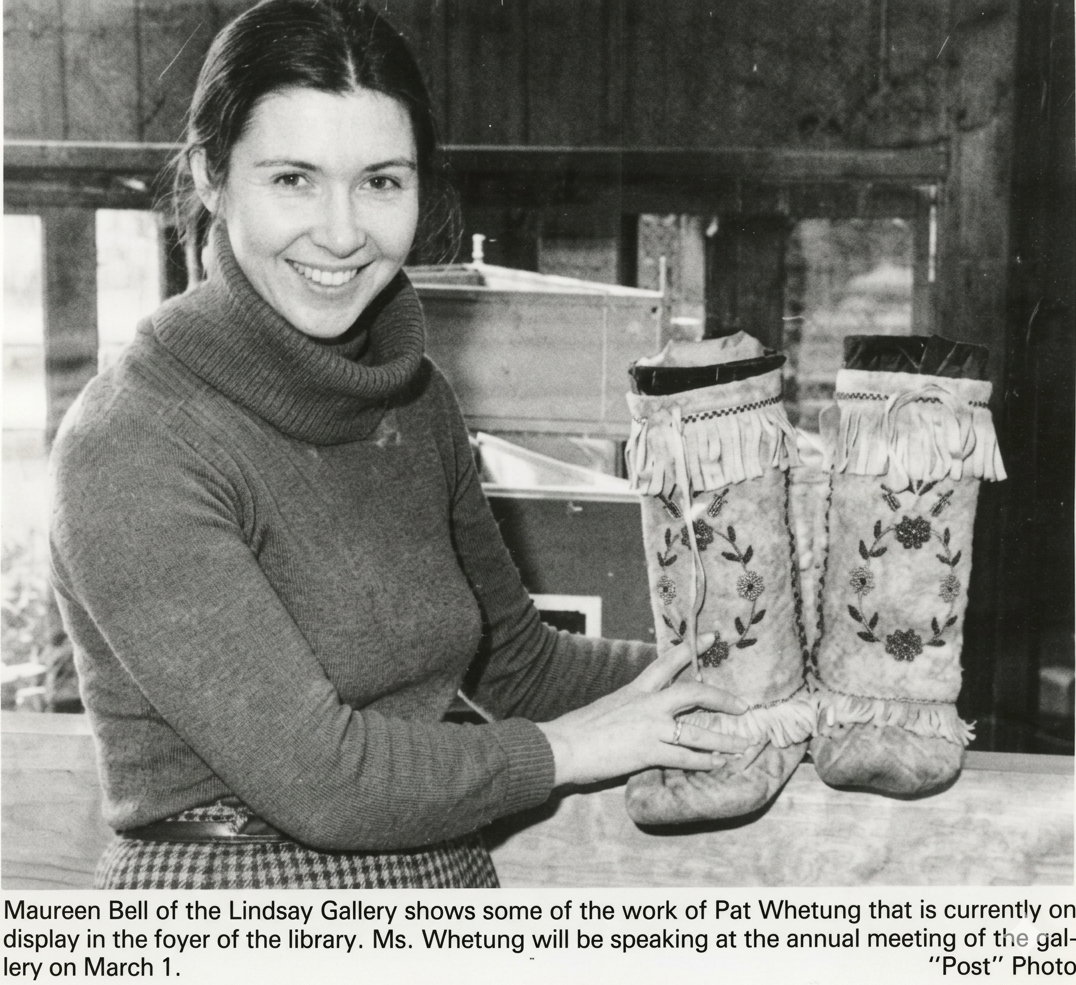
Other artists had shows mounted in the Ethel Flavelle Gallery, particularly if they required more f loor (and wall) space. One of these was Arthur Shilling, the Indigenous artist who had become a household name in Canadian art circles by the time Maureen invited him to do a show at the Gallery in 1982. Maureen remembers him bringing 15 to 20 paintings with him for exhibition. “Hanging an exhibit could take up to two days,” she notes. In addition to mounting artworks, directors had to handle media relations – as well as do up official invitations and mail them out.
Annual meeting minutes of February 25, 1982, indicate that The Lindsay Gallery was going from strength to strength. 10,000 visitors had been reported in 1981, with 22 exhibitions being hung between Studio 8 and the Ethel Flavelle Gallery. Educational kits, focusing on Canadian art and funded by what was then called the Department of Manpower and Immigration, were developed and distributed to schools throughout Victoria County. Board members, led by chair David Walling, praised Maureen for her efforts in expanding the Gallery’s reach.
Funding for all these activities came from a mix of grants and locally driven fundraising initiatives. “Ontario Arts Council grants paid for exhibitions, and while the town gave us money every year, additional fundraising fell on my shoulders,” Maureen tells me.
“We did an art auction on the front lawn of the gallery, complete with cooked quiche and liquor served before the auction started,” Maureen says of one of her most memorable fundraising initiatives. This art auction, which attracted between 50 and 75 attendees, took place in the middle of July 1982, while Lindsay was commemorating its 125th anniversary. Among the guests was the Hon. John Black Aird, Ontario’s 23rd Lieutenant Governor. Dennis Sweeting, best-known for his work as the founding director of Kawartha Summer Theatre, and active in civic life as a municipal reeve, served as auctioneer. “He and Maggie [Sweeting] were always up to help, and the theatre was very vibrant under his leadership,” says Maureen.
Maureen Bell remained at The Lindsay Gallery for another full year, indicating in September of 1983 that she planned to resign from her position effective March 31, 1984, to go into teaching. “I came into this job, grit my teeth and did it,” she told Lindsay Post journalist Penny Barton in a December 18, 1983, interview about her forthcoming departure. Maureen had accomplished a lot over the space of 27 months. “Everyone is sorry to see her go,” noted the Annual General Meeting minutes of March 1, 1984. “Her cheerful presence and helpfulness will be missed.”
Today, Maureen resides in Midland, Ontario, and remains a keen and interested observer of the role galleries play in shaping and sustaining community. Pointing to the Gallery of Indigenous Art at the Midland Cultural Centre, which opened in 2021, she emphasizes the importance of collaborating with Canada’s first peoples in developing programmes and exhibitions. Ensuring that art galleries develop ongoing programming for children – something Maureen prioritized during her tenure in Lindsay – remains an important task.
And finally, Maureen believes that galleries must do all they can to be as accessible and inclusive as possible. “Being aware of your local community is important; you have to offer them something that will interest them, and that they can afford,” she says.
As the Kawartha Art Gallery marks its 50th anniversary, it acknowledges people like Maureen Bell, whose efforts of more than 40 years ago helped pave the way for what it has become and what it will become over the next half century.

Every month, join Research Associate Ian McKechnie as he opens the doors to Kawartha Art Gallery’s archives, sharing the remarkable history and the dedicated individuals who made the City of Kawartha Lakes only public Art Gallery with a Permanent Collection a reality.