Joyce Enslin’s Vision for The Lindsay Gallery, 1976
Written by Ian McKechnie
One of the most important documents in the Kawartha Art Gallery’s archives is a handwritten address given by co-founder Joyce Enslin (1930-2022) at a meeting of the Lindsay Rotary Club in the spring of 1976. The Lindsay Gallery – as it was then called – had opened on April 24 of that year, and while much had been done, the Gallery was still very much a work in progress.
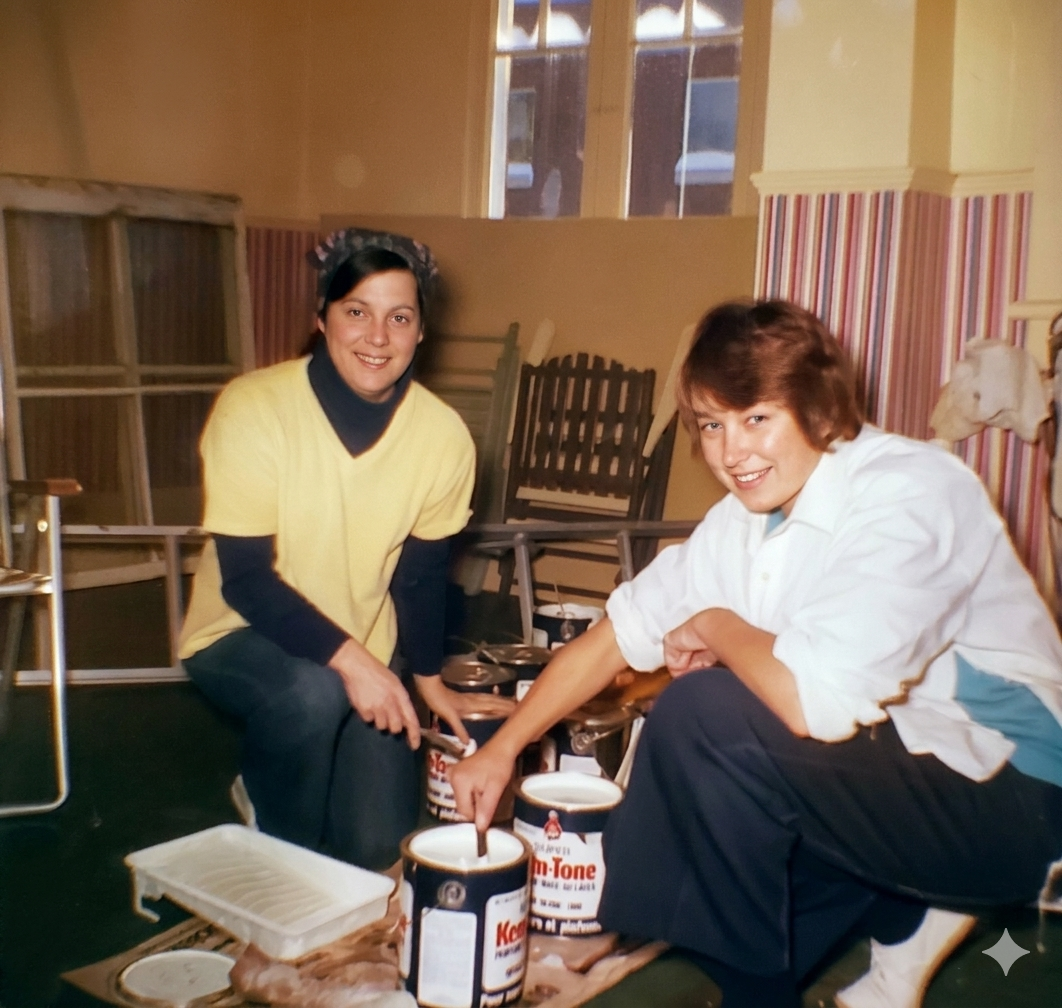
Sandra Ackert and Joyce Enslin
Joyce’s speech has much to say about the dreams and aspirations of those who came together half a century ago to form the Gallery, and in this instalment of Gallery Stories we take a deep dive into her address – highlighting what has changed and what has stayed constant in the Gallery’s ever-evolving story over the past 50 years.
Well Gentlemen, I’m delighted to be here today, to tell you something of the most exciting development to occur in Lindsay in at least a decade! I’m referring of course to the new Lindsay gallery.
I wonder how many of you have had an opportunity of visiting our new gallery, since it opened its doors on April 24th? To those of you who have not, I would like to extend a very personal invitation, to come and see what the excitement is all about at #8 Victoria Avenue North.
The Lindsay Gallery is a public art gallery – your gallery, gentlemen! Dedicated to fostering the development of Canadian arts and crafts, particularly of local origin, and the establishment of a permanent collection, representative of the area that it serves…
Joyce opens her monologue by drawing the Rotarians’ attention to the Gallery’s local – or at least regional – mandate. Although Canadian arts and crafts would be at the forefront, The Lindsay Gallery would not simply duplicate the appearance of other collections. Local artists would be spotlighted, and the permanent collection would reflect the community.
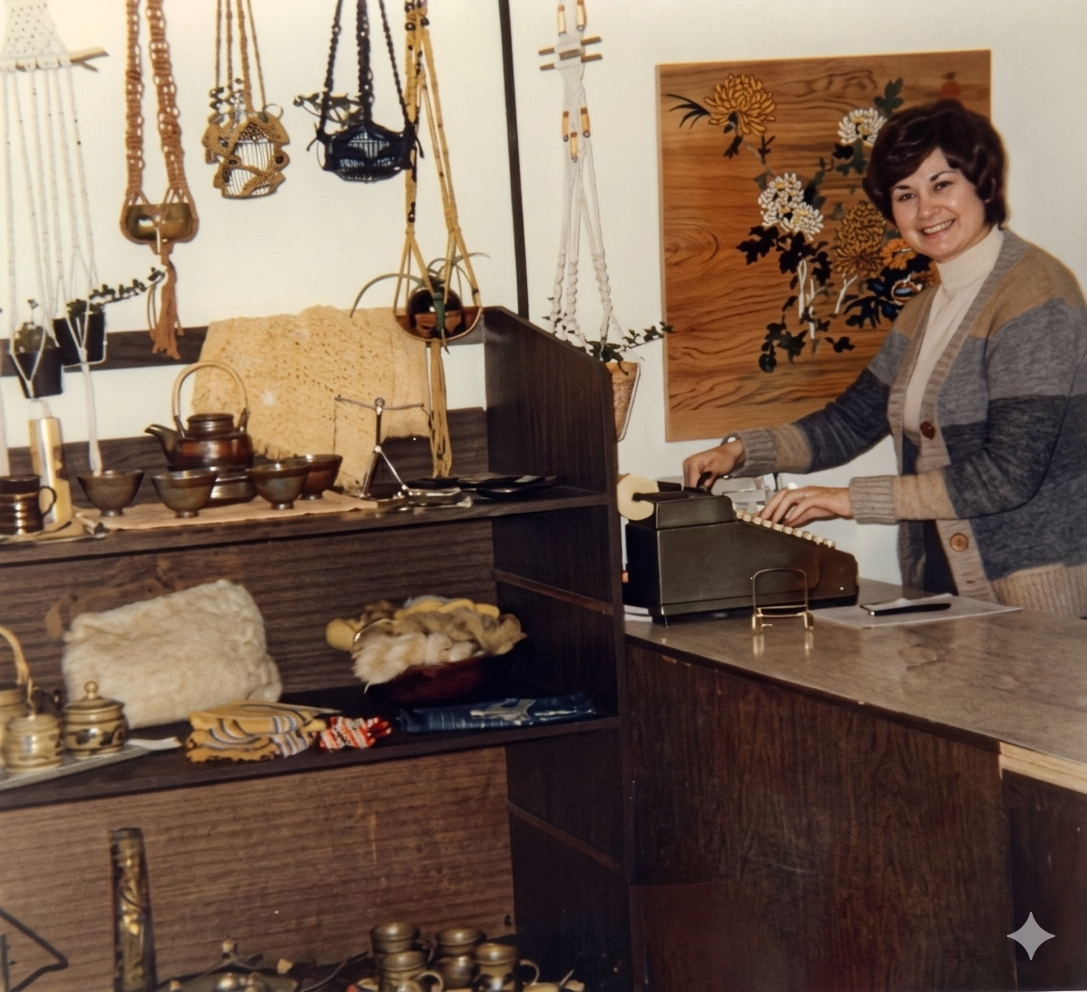
Joyce Enslin in the gift shop
Over the years, this mandate has largely stayed the same. While the permanent collection encompasses the work of artists who may never have set foot in what is now Kawartha Lakes, many of the pieces have a tangible connection to the community. For example, John W.L. Forster’s painting, The Blind – Talbot River, was quite possibly gifted by Forster himself to James W. Laidlaw, of Coboconk. Laidlaw in turn passed it on to his daughter, Jean Shields, who subsequently donated it to The Lindsay Gallery in 1979. If not directly the product of a local artist, these pieces reflect the artistic tastes of local residents past and present.
Perhaps the most significant point here, though, is Joyce’s emphasis on the community having a stake in their gallery. It would not be something that appealed only to professionals, to specialists, or to members of a clique. It would quite literally be “for the art in everyone.”
…Perhaps some of you are asking yourselves: Why does a community need an art gallery? What does a gallery do for a community?
To answer those questions gives me the opportunity to expound on one of my favourite subjects: the place of the art gallery in a community – and the place of the Lindsay gallery, in particular, in our town of Lindsay.
The growth in the number and quality of galleries in Ontario in the last few years is phenomenal, and proves that the need for public art galleries is real. Art is a social, economic, and educational force in the life of our society. Art is an integral part of everyone’s life. Can you possibly imagine what your life would be like without the artist? It is the artist who designs our houses, our cars, our clothes and a myriad of other commodities which we are inclined to take for granted. It is the artist who enhances the world around us – and it [is] the gallery which provides the artist with the forum which with to measure achievements against provincial, national, and international standards…
It is sometimes assumed that the arts are a “nice-to-have,” not a “need-to-have.” They are the frills along the edge of a community, and if they get removed – well, the core of that community will remain unaffected. Such is the challenge of creators and those institutions that support them. Joyce turns this thinking on its head, reminding her listeners that art can in fact be discerned in the everyday, the mundane, the mechanical, and utilitarian.
…Our community has a need to see original works of art. For too long, we have been deprived of that right. It is through constant exposure to the visual arts that we develop discernment of taste. The public gallery is dedicated to creating an awareness and appreciation of the visual arts in our daily life, thus developing a public which can exercise sound judgement in matters of taste. Only when the public feels confident of its judgement and sees artists in their historic and aesthetic perspective will it be able to support them on the basis of quality…
Here Joyce’s address turns somewhat subjective. Was the community really deprived of the right to see original works of art? There was certainly no shortage of artists in the community: one thinks here of such figures as W.A. Goodwin, Anne Langton, and W.A. Sherwood, to name a few stalwarts from the nineteenth century whose work enjoyed local and national acclaim. Art exhibits had for decades been part and parcel of the annual Lindsay Central Exhibition. Even without a dedicated gallery space, the visual arts were alive and well in Lindsay.
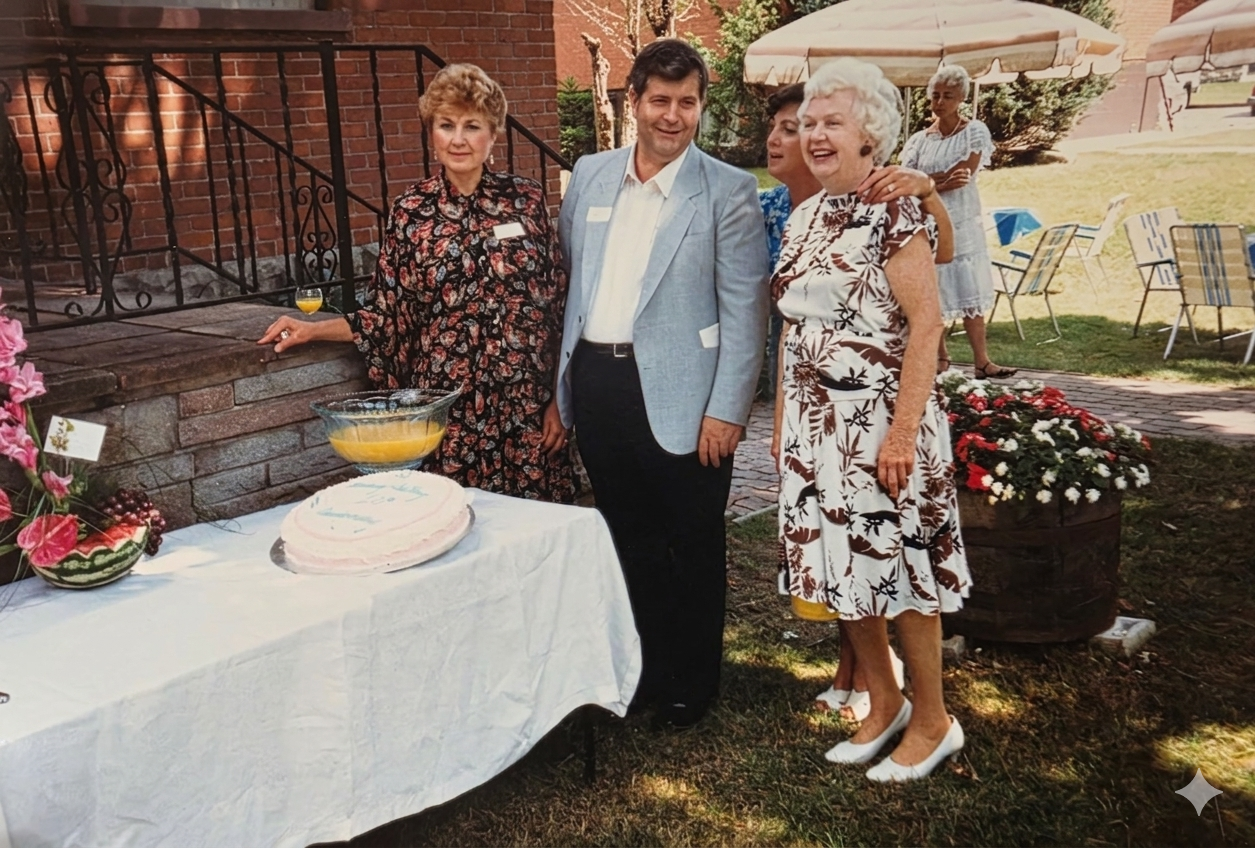
Joyce Enslin, Chris Karkabasis, Sandra Ackert, Marion Laroque
Although Joyce was right in insisting that a dedicated art gallery would permit original works of art to be exposed to a larger audience, her observation about a gallery’s role in developing a public which can exercise sound judgement in matters of taste raises some questions.
What exactly does this mean? Are there some tastes in art that are more sound, more acceptable than others? Is beauty not in the eye of the beholder?
A cursory glance at some exhibition brochures prepared by The Lindsay Gallery in the late 1970s, laden with flowery language and technical terminology, suggests that art appreciation was something esoteric and exclusive, something accessible only to those with a specially-trained eye. (Indeed, a letter to the editor in 1992 asked: “Why does the gallery ignore the general public? Is it trying to create some kind of ‘elite’ image?”) Trying to strike a balance between “developing a public which can exercise sound judgement in matters of taste” while also making art accessible to those who are not specialists has been, and remains, a balancing act.
…Our community has a need to collect works of art. The creation of a permanent collection guarantees a continuous record of the creative activities of our community that will be preserved for future generations. Only a gallery, with its special facilities and expertise should be responsible for the care and handling of these important treasures of our artistic heritage.
Our community has an ever-increasing need to participate in the creative process. In these times of leisure, the public art gallery is an important element in open-sector education. An appreciation and learning about art must happen with direct exposure to works of art, shown to their best advantage. This means an artgallery. The opportunity to learn comes through exhibitions, seminars, lectures, and workshops. Art galleries have often taken the initiative in handling educational programmes in the public school system. Art galleries enhance the quality of life – for those that take advantage of them…
From its inception, The Lindsay Gallery could not merely be a place to go and admire art, it also had to immerse the community in the arts via hands-on programmes. Over the past 50 years, the Gallery has organized a speaker series, Tea Tyme talks, and a plethora of workshops for a range of audiences. It has indeed enhanced the quality of life in Kawartha Lakes – and not merely by expecting its audiences to take advantage of its offerings by visiting its space, but by going out into the community in collaboration with schools and other like-minded organizations.
…The art gallery is an immeasurably important factor in the development of the creative visual artists in our community. Besides exposing the artist with a variety of visual experiences, and a standard by which to measure development, the gallery will provide a market for the sale of local work. Thus, the gallery stimulates the creative processes, will increase the market levels, and keep the flow of money in circulation.
The Lindsay Gallery will also be an area tourist attraction. In Lindsay, with its large annual tourist influx, we have much need for a facility of this nature. The gallery will provide an important area of tourist interest, impressing the visitor to our community with our cultural awareness. The lustre which has been given to Lindsay by the establishment of the Academy Theatre will be further enhanced and complemented by the Lindsay Gallery, encouraging the tourist to linger longer, once the bread and milk have been bought.
A public art gallery enhances the ability of a community to attract new business and industry. Corporations, before settling in a community, always investigate an area’s cultural activities. The establishment of the Lindsay Gallery will weigh heavily with them as a decisive factor in the town’s favour, let me assure you gentlemen…
When The Lindsay Gallery opened its doors 50 years ago, the local economy was in a state of flux. The industrial base that had thrived for most of the twentieth century was still making its presence felt, but within 15 years many of the local factories had either closed up shop or were on the verge of doing so. It is interesting, therefore, that Joyce tells her audience that cultural institutions draw corporations into a community. Trends in economic development have shifted over the past 50 years, and “smokestack chasing” – that is, attracting large industrial concerns to town to set up a branch plant – has given way to supporting small businesses, tourism, and especially the creative economy. The Kawartha Art Gallery in its advocacy has always reminded decision-makers that the arts are a worthwhile investment in driving local economic activity.
…You have been provided with many reasons, gentlemen, why you need the Lindsay Gallery –
(1) as a place where works of art can be properly exhibited, protected, and preserved
(2) as a place where interpretive and instructional programmes can be conducted
(3) as a place that encourages the development of artistic talent in Lindsay through exhibition and sale of works by Canadian artists
(4) as an attraction for the tourist and business dollar.
Now, I’ll tell you why the Lindsay Gallery needs you:
The Lindsay Gallery is incorporated as a public art gallery, yet receives no financial support of any kind. The building in which it is housed is rented from the town of Lindsay, and we are liable for all utilities. While we have the town council’s approval to operate this public service, we receive no municipal financial support.
We have applied to the provincial government for assistance, under a Wintario Capital Costs scheme, and are presently awaiting the outcome. In the meantime the onus is on us, to raise one third of the money needed, toward the grant.
The sustaining force behind the gallery is the Kawartha Arts and Crafts Association, a group of community-minded volunteers who have dedicated their time and talents to developing this public art gallery in Lindsay. Courage, selflessness, and a buoyant sense of humour have all been necessary ingredients in the creation of this gallery. The fun we’ve had this past winter of subnormal temperatures! When we took over the house in January, half the storm windows were not installed. The fuel bills were astronomical! The furnace and controls have really given us a lot of trouble. I wish I could say they’re over, but warm weather has effected a temporary cure, at any rate. Those 12 foot walls and ceilings took seemingly endless gallons of paint – I should know! There were times that I felt like Michaelangelo in the Sistine Chapel! And I remember the wintery morning when a window blew open and froze the plumbing in the bathroom – temporarily curing a terminal case of a dripping faucet. Came spring, and we discovered the basement was equipped with running water – unfortunately there was no sink and faucet.
However, we heroically overcame – the exhibition space is open! Yes – open…but a long way from being adequate! We lack the funds to complete the job, yet. These lovely, airy, 12 foot ceilings are festooned with a variety of ancient lighting apparatus circa 1900-1920. No matter how much they may be cherished by the antique buff, as gallery lighting they have to be classified as totally unacceptable.
We desperately need humidity control too, gentlemen, and even though we are next door to the police station, and a stone’s throw from the fire department, a security and alarm system is an absolute requirement.
Resource equipment is needed for the teaching and the demonstration of various aspects of the arts and crafts. This is an important area of gallery operation, if we are to truly fulfil our obligations of public service to our community.
We also require fabric panels, such as other galleries employ…
The preceding paragraphs speak vividly to the challenges faced by an emerging not-for-profit organization working with what it has and adapting to the circumstances – all the while dreaming of something better. In many ways Joyce’s description of the Gallery’s first home at 8 Victoria Avenue North is a fitting metaphor: the artist sees not simply what is, but what something can become. Where some might have seen an eyesore, the artist sees a canvas. Where some might have seen an old building unsuitable for adaptive reuse, Joyce and her team saw an opportunity. Insurmountable challenges become exciting opportunities.
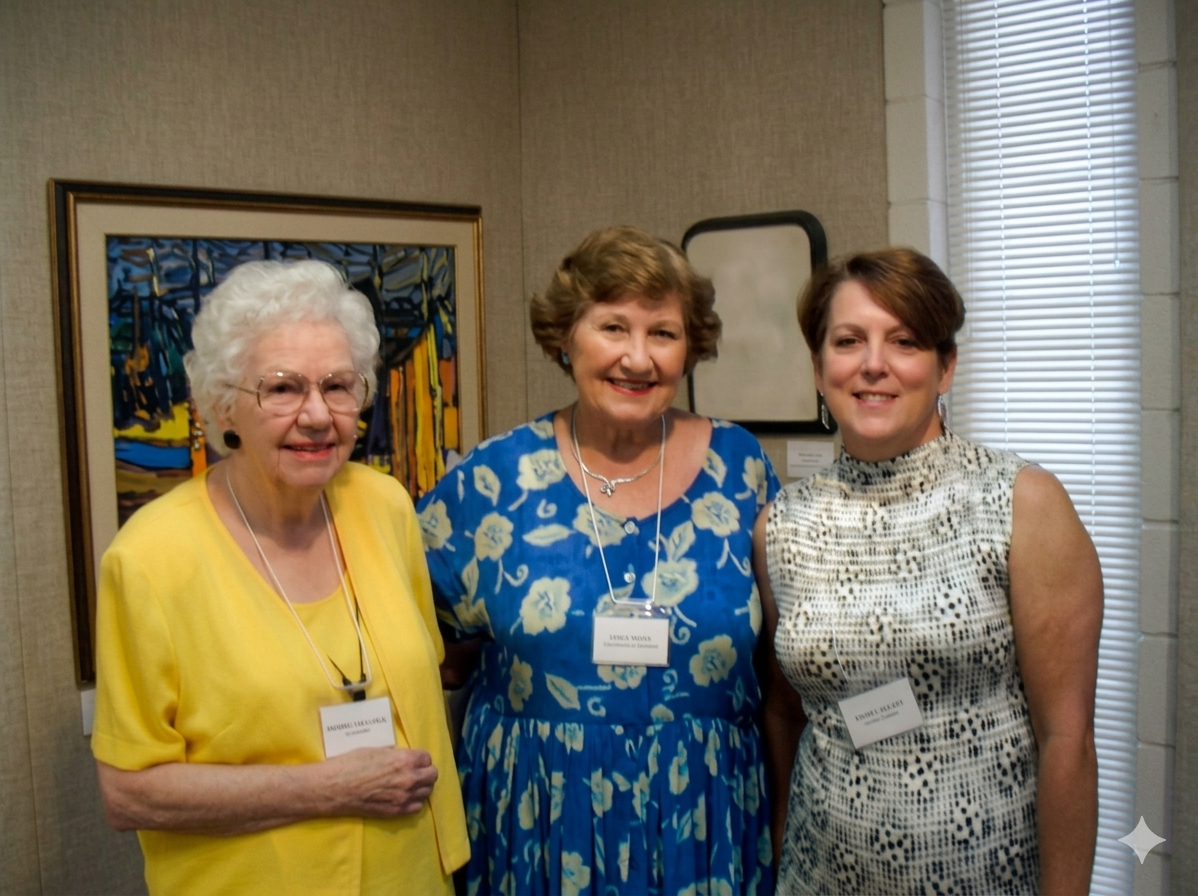
Marion Laroque, Joyce Enslin, Sandra Ackert
Over the course of its 50-year history, the Gallery has been confronted by a host of challenges: inadequate facilities, a revolving door of directors, indifference, charges of elitism, financial instability, temporary closure, and more recently a worldwide pandemic. But overshadowing those challenges in the annals of the Gallery’s history have been memorable moments enjoyed in the company of other creators at exhibit openings, people young and old who have discerned hidden talents through their participation in the Gallery’s varied programmes, and opportunities to discover and celebrate the art in everyone.
…That is the situation as it exists: much has been done, but much remains to be done. Together, we can build a gallery of which we can be proud, and which will be a true heritage for future generations.
Few endeavours are more worthy of perseverance. The artistic and creative development of our community is at the crossroads.
Our community needs and deserves this service which we are voluntarily providing. For too long we have been deprived of this resource. For too long have our creative citizens been neglected. It is just those very citizens who posses the greatest innate capacity to endow life with the richest, the deepest meanings. Surely, gentlemen, what we need is a very small price indeed to pay for the rich rewards which will transpire – the benefits which will accrue through the development of this facility. This public facility – to which every individual is given free access, to use for the greater development of his or her own personality.
We are looking to you, Rotarians, for your moral and financial assistance. Rotarians, if we are to enable to carry on this important endeavour, we are looking for $15,000.
The words Joyce Enslin left with the Rotarians half a century ago ring as true today as the Kawartha Art Gallery celebrates its 50th birthday: “Much has been done, but much remains to be done. Together, we can build a gallery of which we can be proud, and which will be a true heritage for future generations.”
Postscript: Much indeed remains to be done – and not all of it can be accomplished merely through donations made by service clubs, corporations, or private citizens, appreciated though these are. In the 50 years since the late Joyce Enslin gave this address, municipal support for cultural institutions such as The Lindsay Gallery has waffled between lukewarm enthusiasm and cynical indifference. The latter nearly pushed the Gallery into oblivion during the 1990s. More than 30 years later, however, a renewed emphasis on the economic importance of arts, culture, and heritage has seen the City of Kawartha Lakes step up its support of the sector. Starting in 2023, for example, the Kawartha Art Gallery received a level of annual operational support from the City of Kawartha Lakes via a partnership agreement that will be revisited upon each new term of city council. Recognizing that this sector generates nearly $30 billion annually to the provincial GDP (more than agriculture, forestry, fishing, and hunting combined!) – and roughly $43 million in economic impact in Kawartha Lakes alone – it is hoped that decision-makers at all levels of government will continue to see the value of supporting the arts in the communities they serve.

Every month, join Research Associate Ian McKechnie as he opens the doors to Kawartha Art Gallery’s archives, sharing the remarkable history and the dedicated individuals who made the City of Kawartha Lakes only public Art Gallery with a Permanent Collection a reality.