Looking back with Sandra Ackert
Written by Ian McKechnie
Talking with people who were involved with getting The Lindsay Gallery up and running half a century ago affords us a unique opportunity to understand what was going on during those first few months and years of operations.
Like those behind the formation of the Victoria County Historical Society (VCHS) that preceded the Gallery's establishment by almost 20 years – and to a lesser extent, the Academy Theatre Foundation – the founding members of The Lindsay Gallery had three things in common: a vision, an empty building, and a band of volunteers who were willing to transform a vision and a building into something amazing.
The VCHS spent its formative years in Lindsay's empty Canadian Pacific Railway station; not until 1962 would it have a space of its own. The Academy Theatre Foundation of course had a building, but it needed significant renovation. Both the VCHS and the Gallery depended for their first few years on volunteers to serve in the role of Curator. Both would in due time relocate their operations to purpose-built spaces. And all three organizations have over the years weathered their own storms – but have persisted in celebrating and strengthening our community's culture and heritage sectors.
But they all began with a group of visionaries. And earlier this year, I had the opportunity to sit down and chat with one of those visionaries – Sandra Ackert. What follows is a transcription of my conversation with her (which has been edited for clarity and length):
On how The Lindsay Gallery got its start…
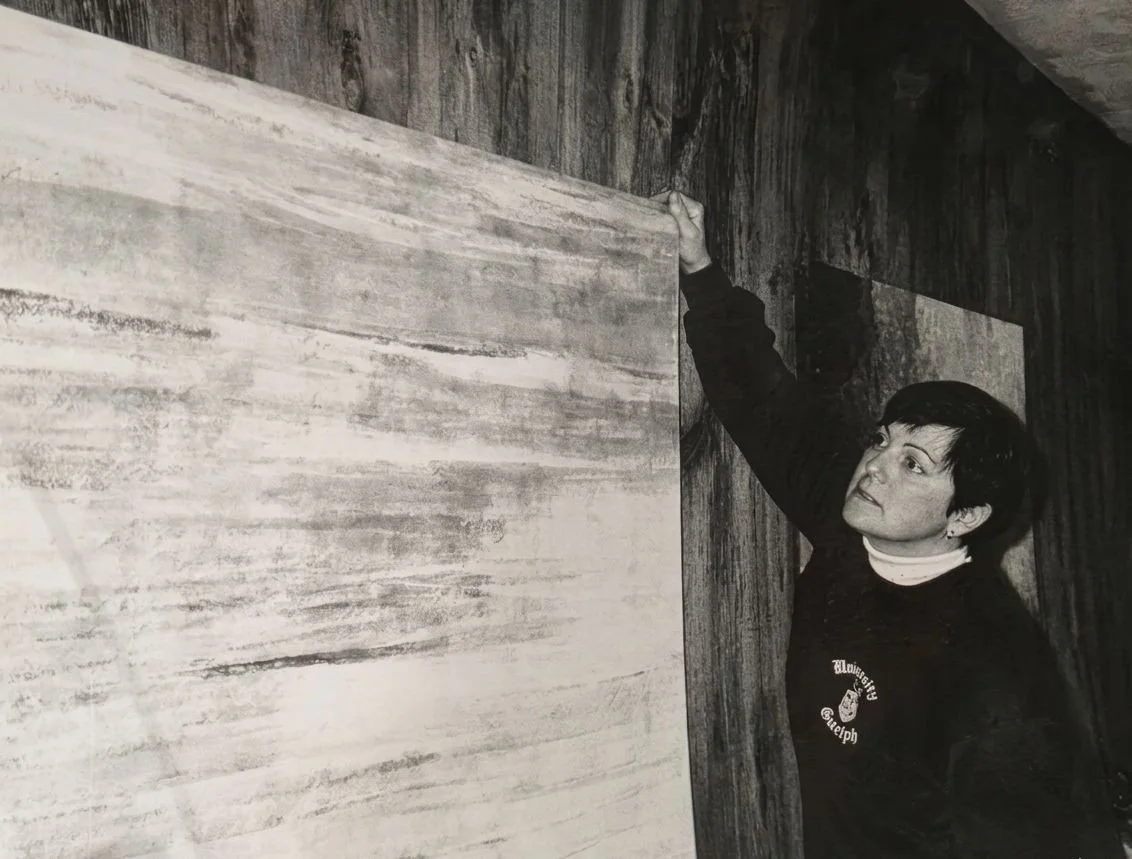
Sandra Ackert
I remember the day I was with Joyce Enslin, and we were in a car and we were outside the building that became Studio 8. We knew it was available; that the town owned it. And we were talking about a space for a gallery, because we wanted to start an art gallery. Apparently, there was not one that we were aware of at the time. So, we sat there and Joyce Enslin was sketching the building. Then we had a meeting – this was 1976 – so we decided "let's have a group together," and we met at the house, and we were all seated around, and there must have been, oh, maybe 20 people. I can't remember how many. But we discussed it [turning the building into a gallery], and there were a lot of pros and cons about whether we could do it, and whether we'd have support. And I remember, I stood up and I said "What have we got to lose? Let's go for it." And we forged ahead.
On renovating Studio 8:
We had to get into the building; we ripped up linoleum and worked on the floors and we had a lot of help – we painted [the] walls, and had a plumber in to fix the bathrooms (we had only one bathroom). It was really exciting to do that. And it just evolved.
On memorable shows at The Lindsay Gallery:
We planned different shows. We had friends from Toronto, artists that were teaching in Haliburton, that we had come in to exhibit their work. And they were really good artists, and here we were with this gallery starting out. One was Glen Elliott. One that I do remember was a group that I belonged to in Chatham – there were ten of us and we called ourselves Studio 10. We invited them all to come up and have a show at the space, at Studio 8. And it was a very good show. I remember being excited about it, because all my friends stayed at our house that time they came up for the show.
On Michael Burtch, the Gallery's first professional curator:
The first true curator was Michael Burtch. He came in and took over and [while] we [helped plan] shows, he was the main person. One show sticks in my mind. He – Michael – thought, "Oh, this room isn't going to work." So he said, "I've got to paint the walls." We painted the walls black in the main gallery room to suit this particular show that was there. And [laughing] here he was, I just remember the black, and it didn't bother him in the least, he thought, "What the heck, I'm in charge here, we'll do it." Michael left the Gallery and he went to Sault Ste Marie into the Algoma Gallery there as a curator. I don't think he's still doing it now, but he was a really nice person.
On Maureen Bell, the Gallery's youngest executive director:
Maureen Bell – who became a really good friend of mine, and she's still a good friend – was the Curator for a while. She had worked at the McMichael Gallery in the Indigenous section; she was working there putting shows together.
On her involvement with the Gallery later in the 1980s:
I was probably active for about eleven years and then I decided I needed time so I could do my painting, look after my family, so I really wasn't too involved for a certain period. I know I was on the board – that was in the 80s; I was chairperson of the board and worked with Rod Ainsworth [Vice-Chair of the Board of Governors in 1982], when he was involved at that time. The only thing I remember about Rod Malham (the Gallery's Executive Director from 1986 through 1992) was that he was into making pottery. That was on the side, of course, and I ended up buying some garden pots he made. The Volunteer Association did a lot of great fundraising events for the Gallery [during this period]; they'd have a tea or a lunch or just different things at Studio 8. They enjoyed it.
On A.J. Casson's visit in 1979:
I don't remember organizing it, but I remember the excitement of him coming to the Gallery; I understand that his painting has been restored (Poplar Grove, Casson's abstract oil painting from ca. 1956, which was cleaned in 2026).
On the art rental service and meeting Arthur Shilling:
We did have an art rental, and I was involved in picking up paintings for the art rental. One story in particular stands out. Arthur Shilling said he would give us some paintings for the art rental. So, Maureen Bell, the Curator, and I went up to his place at Rama, and we had a tour of where he painted. He had students there, too, and he gave us some small pieces, and he asked Maureen if he [could do] her portrait. So, they set up a couple of appointments for her to go, and he did a beautiful, blue-eyed painting of Maureen in his style. Foolishly, I didn't pick up one of his paintings when it was in the rental because they weren't for sale, but Maureen ended up with quite a few of his paintings. It was a lot of work because I usually ended up going, taking pieces to people, picking up paintings, and here I was on the road [a lot]. It was just another little fun thing to do.
On putting shows together:
I remember putting shows [up]; I would actually do the hanging of the paintings with help, and I didn't really have any training to do that – but I would look at [a painting] and think, "oh, that's perfect." Pam [Logan] was not considered a Curator, but she was our Exhibition Coordinator – a role that involved setting up and organizing the shows, [as well as] finding the artists. We just sort of worked at it, decided what we were going to do, and made sure we had some interesting shows.
Afterword
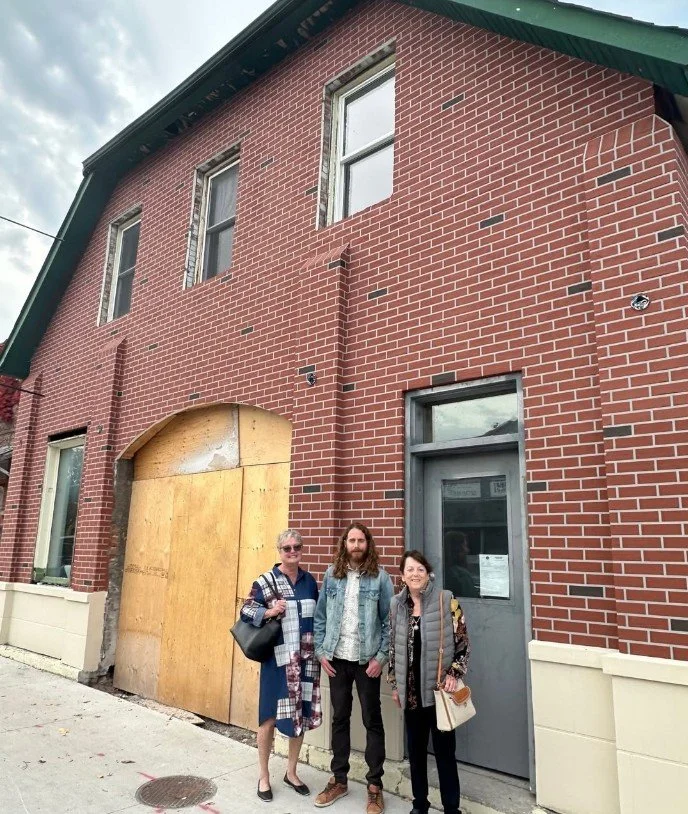
Susan Taylor, Wesley Found, Sandra Ackert
It is all too easy, as organizations grow and evolve, to forget about the contributions of those who laid the foundations on which successive boards and leadership teams have built. Especially as organizations professionalize their operations and expand beyond a founding group's original vision, the memory of those who "got the doors open" can fade from view. It is vitally important, therefore, that organizations in Kawartha Lakes – and not only those in the cultural sector – keep retelling their origin stories: in moments of crisis, moments of transition, and moments of triumph. They keep us grounded, and always mindful of our mission and vision as we move ahead into new opportunities, new approaches – and even new spaces. Thank you, Sandra, for being one such custodian of the Kawartha Art Gallery's origin story.
Every month, join Research Associate Ian McKechnie as he opens the doors to Kawartha Art Gallery’s archives, sharing the remarkable history and the dedicated individuals who made the City of Kawartha Lakes only public Art Gallery with a Permanent Collection a reality.