What could have been
Written by Ian McKechnie
April 2026 saw a public meeting take place in one of the rooms on the second floor of the Victoria Park Armoury here in Lindsay. The meeting in question was organized to solicit feedback as the City of Kawartha Lakes develops its 2030–2040 Cultural Master Plan. As one of the consultants presenting his firm's findings at this meeting remarked: "There seems to be a lot of siloing happening, and maybe we all need to collaborate a bit more."
Collaborate. Collaboration. Collaborative. These have become big buzzwords in the arts, culture, and heritage sector over the last decade or so – not least here in Kawartha Lakes. And with good reason, too. Putting aside differences and investigating creative and constructive ways by which two or more organizations can work together for the greater good of all is a laudable objective, indeed.
Yet collaboration among the various players in this sector is not a new concept in Kawartha Lakes – even though it has sometimes been regarded by its promoters as a novel idea, one that this community is only now slowly starting to appreciate.
No. It has a long and winding history, filled with best-laid plans that went awry, daring dreams that were dashed in disappointment, and what often felt like political intrigue – or at least inertia. More positively, this tale reminds us that collaboration has often been citizen-driven, propelled not by focus groups and municipal leadership but by organizations seeking to find common ground and a more efficient way of utilizing resources.
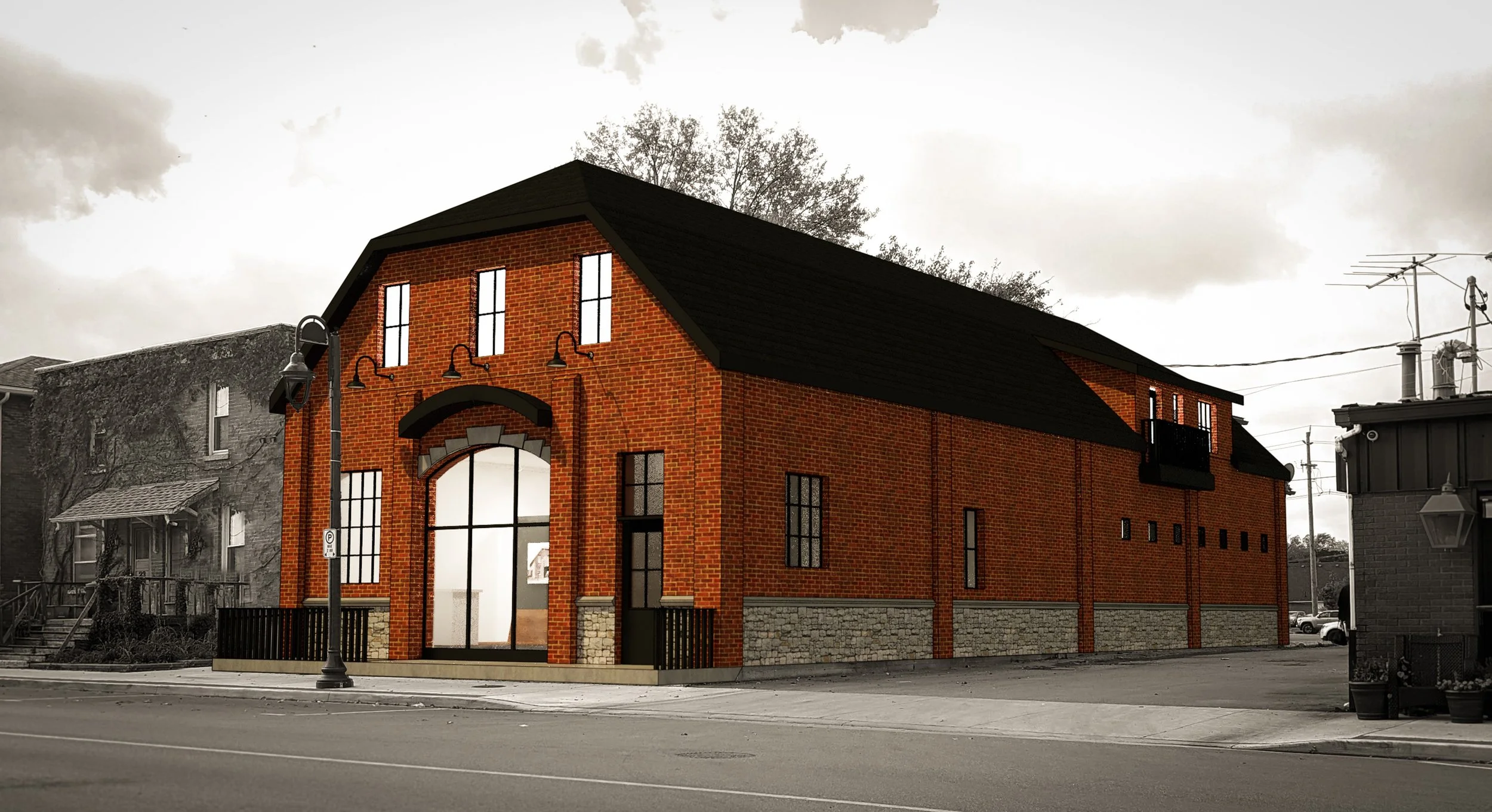
And nowhere is this story more true than in the Kawartha Art Gallery's long search for a new home – a search that will, at last, be coming to fruition later this summer, when it relocates to 19 Cambridge Street South.
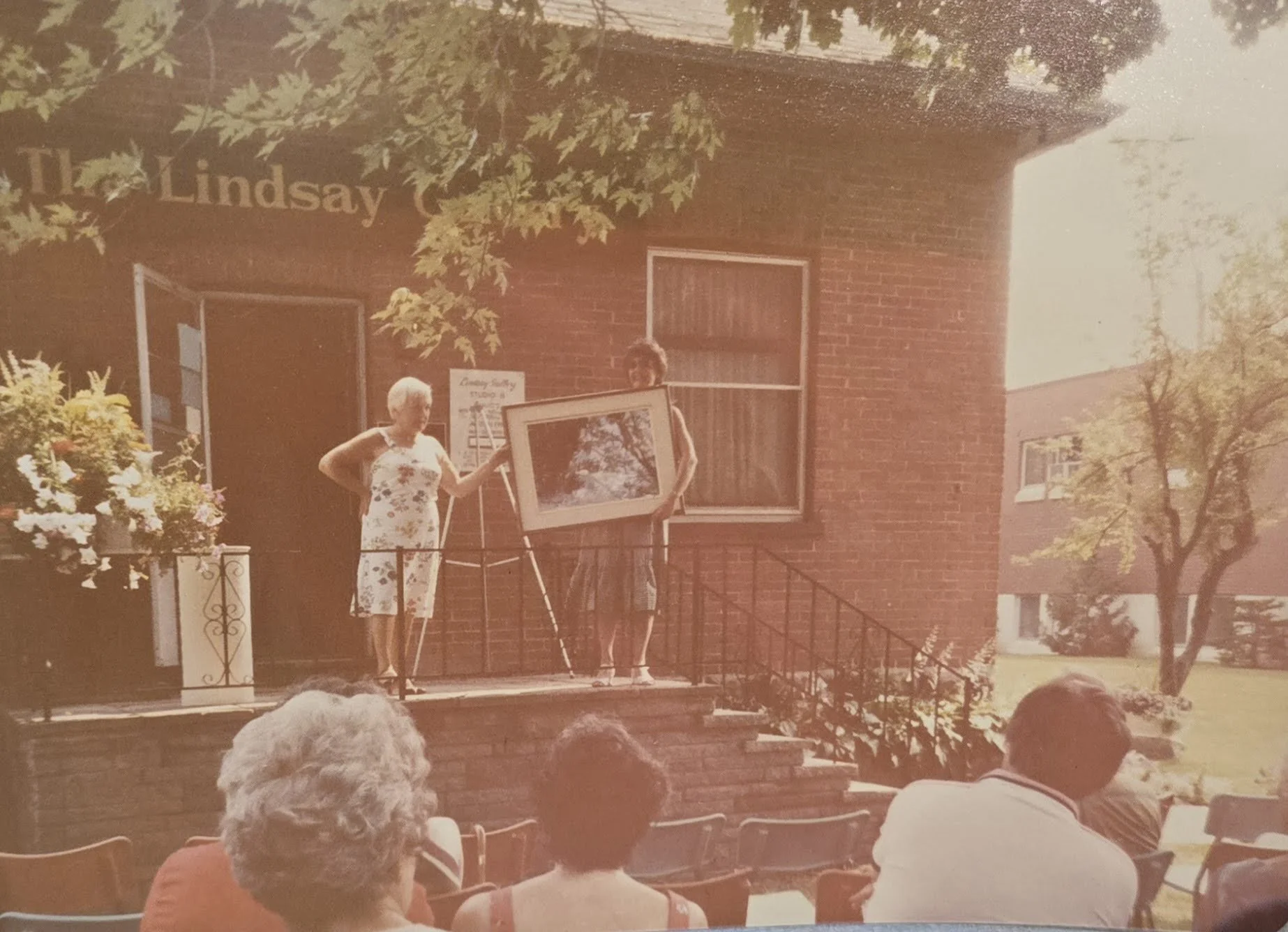
The first home of The Lindsay Gallery, affectionately known as "Studio 8," is pictured here in ca. 1982 during an art auction. Kawartha Art Gallery collection.
"Open…but a long way from being adequate!"
Such were the words of founding member Joyce Enslin when she addressed the Lindsay Rotary Club in 1976. Joyce was telling the Rotarians about what was required to bring the fledgeling Gallery up to standards worthy of an institution that would attract tourists and instil in residents a greater appreciation for the arts. The little red-brick cottage at 8 Victoria Avenue North was sufficient, but indeed "a long way from being adequate!"
And yet it remained in use for nearly 20 years – a true testament to the dedication of successive boards, directors, and volunteers who made a less-than-adequate space work.
In 1978, a new gallery space opened on the second floor of the then-new addition to the Lindsay Public Library. Formally known as the Ethel Flavelle Gallery, this space was used in tandem with the exhibition spaces at 8 Victoria Avenue North off and on until around 1994.
As previous director Maureen Bell has pointed out, maintaining two gallery spaces simultaneously demanded a lot from both staff and volunteers.
Meanwhile, over at the western edge of Lindsay, the Victoria County Museum was dealing with its own set of challenges. It had occupied a purpose-built museum structure here since 1962, but a combination of factors was undermining its ability to carry on for much longer at this location. Being situated literally on what was then the outskirts of Lindsay might have boded well for an institution that had since its founding in 1957 grown up around a collection of farm implements and large artefacts with provenance in rural Victoria County.
But as commercial and retail land-use grew in that part of town, the museum's semi-rural location became almost invisible, with a downturn in visitors being the result. It lacked a cohesive curatorial focus, waffling between generic exhibits about "the pioneers" and a more general emphasis on Victoria County. And the building itself was apparently not well-constructed: it was neither weatherproofed nor did it sport internal climate controls.
By the late 1980s, then, both The Lindsay Gallery and the Victoria County Museum were housed in spaces that, while open for business, were "a long way from being adequate."
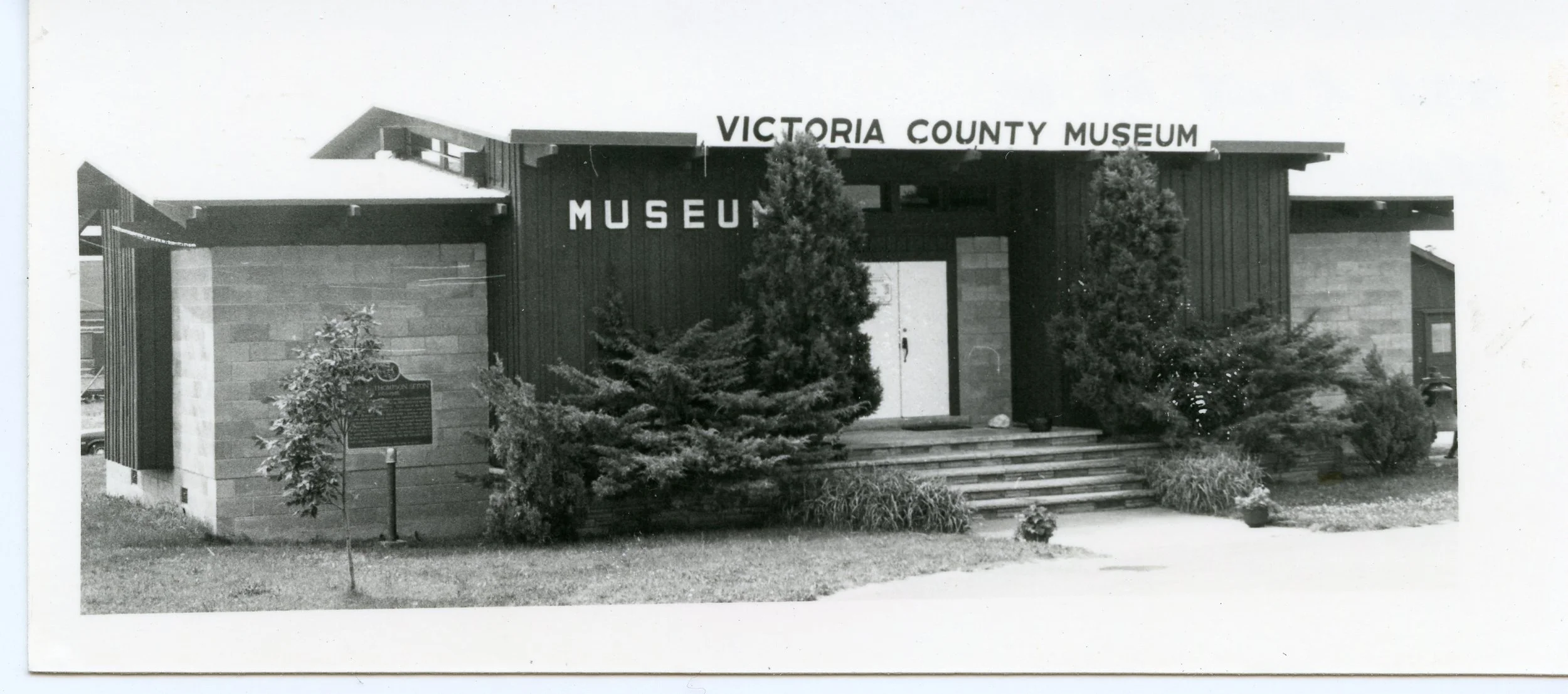
The Victoria County Historical Society called this building home for more than 30 years. Located at the west end of Kent Street, it was deemed inadequate in a 1990 feasibility study. Image courtesy Kawartha Lakes Museum & Archives.
Big Buildings, Big Dreams: Part 1
Lindsay was undergoing significant economic changes by this time, and its once-vibrant industrial landscape was fast becoming a shadow of its former self. Enormous factory buildings sat vacant or were close to becoming so.
One such building was an Edwardian-era factory straddling a site between Lindsay Street North and the Scugog River that had housed various firms – including, ironically, the Canada Crayon Company – since its construction around 1906. By the 1980s, it was known as the "Shaft Machine Building," after its most recent occupant. Another building attracting considerable comment at this time was the old Needler & Sadler flour mill, which had been reduced to a stone shell following a fire in 1978. Both of these structures would become the subject of intense public debate over the course of the 1980s and 1990s – with both The Lindsay Gallery and the Victoria County Museum figuring into the conversation.
Conversations in the mid-1980s, led by the late Jamie McQuarrie (a lawyer, community leader, and longtime member of the Lindsay Board of Parks Management – and, full disclosure, my maternal grandfather), mused about the possibility of older houses along the west side of Lindsay Street North being acquired and turned into an enclave for artists. The Shaft Machine Building, located at the north end of this block, would function as an anchor and feature a combination museum and art gallery.
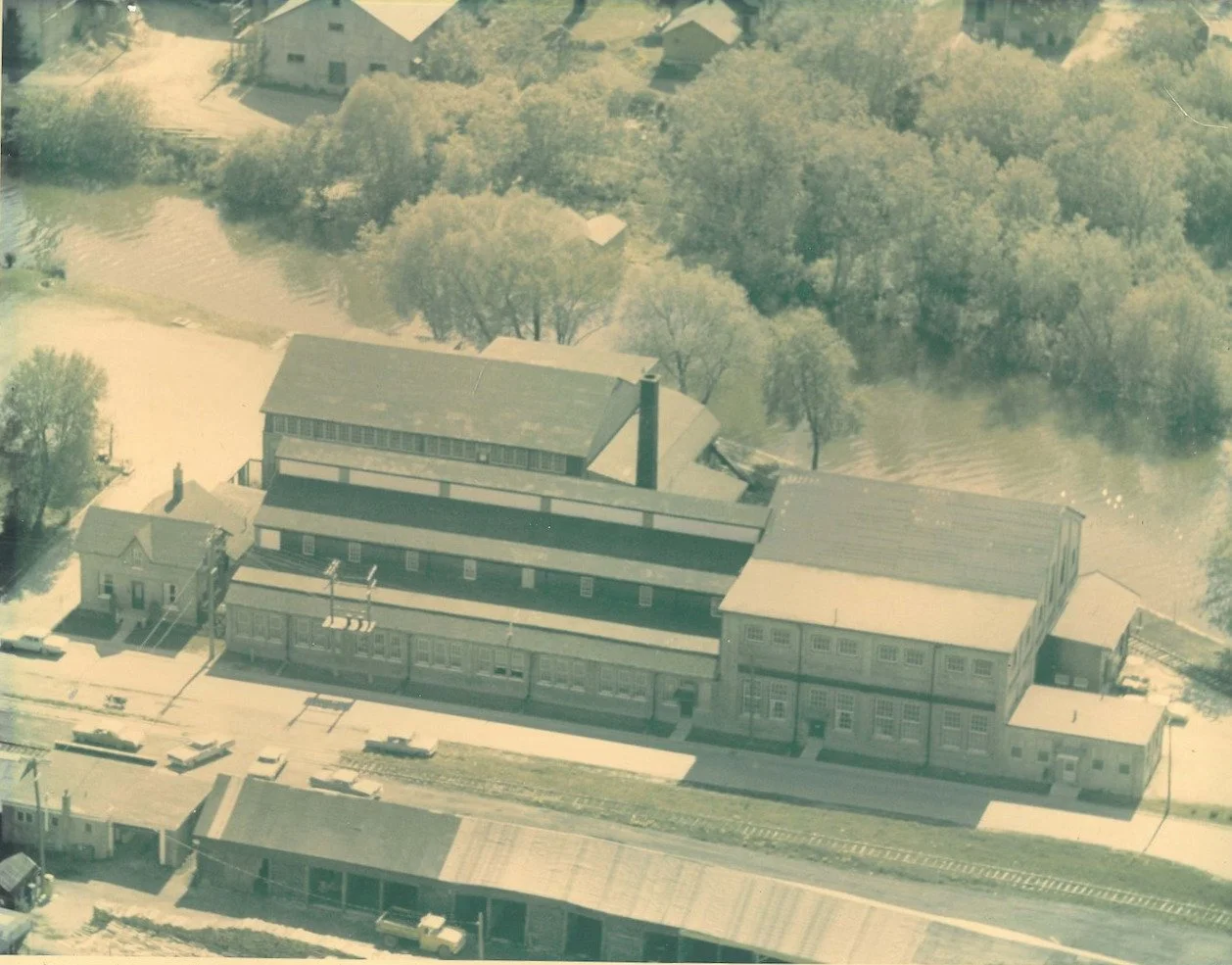
The Shaft Machine building was a sprawling industrial complex built about 1906 on the east bank of the Scugog River. It was under serious consideration in the late 1980s as a possible arts, culture, and heritage centre. The building was demolished around 2000. Image courtesy Kawartha Lakes Museum & Archives, 1999.9.7.
By 1988, a Cultural Committee, comprised of representatives from The Lindsay Gallery, the Victoria County Museum, and Lindsay Little Theatre, had been established, with Rod Malham – then the Director of The Lindsay Gallery – serving as its chairperson. (The artist enclave idea eventually went by the wayside, but the committee was excited about the possibilities afforded by the vacant Shaft Machine Building.)
Malham went before Council, and, as reported in the Lindsay Daily Post on June 21, 1988, asked "…that if a feasibility study were to be completed, stating that the Shaft Machine Building was capable of housing a 150 seat theatre, an art gallery, and a museum, that the Town grant the committee the building, rent free, tax free, and insured."
Malham's report to the Board of Directors of The Lindsay Gallery, dated March 1, 1990, was optimistic: "The study did show that the cultural sector does have the support of people in Lindsay and Victoria County and there is support of people in Lindsay and there is support for the development of a new cultural facility."
Unfortunately, the feasibility study's final report, released in July of 1990, specifically recommended against turning the Shaft Machine Building into a cultural centre.
The consultants tasked with studying the matter concluded that the building was simply too large to justify a combined museum and art gallery (looking back 36 years on, this seems like a shortsighted conclusion, given how both the museum and art gallery would subsequently grow in terms of collections and programming capacity).
They also pointed out that neither organization would be able to run the operation without a massive injection of operating funding from the Town of Lindsay – which, they concluded, was not particularly willing to invest in the cultural sector. The feasibility study was blunt about this reality: "Redevelopment of the Shaft Machines Building and new facilities for the cultural groups are not on Town Council's current agenda; culture is, in fact, low on the Town's priority list." The report reminded its readers – that is, Malham and his colleagues on the Cultural Committee – that the town was being conservative in its spending on account of cost overruns associated with the construction of the Lindsay Recreation Complex nearly 15 years before. Council was likewise concerned about mitigating public criticism over raising taxes. (Though the feasibility study doesn't explicitly say so, the recession sweeping across Canada at the time surely exacerbated concerns over public spending.)
Finally, the feasibility study felt that the probability of a new bridge linking Colborne Street East and West would undermine efforts to redevelop the Shaft Machine Building into a cultural centre, as would plans to relocate Brewers' Retail (i.e. "The Beer Store") from its then-current location beside the Old Mill to a site on Lindsay Street North across the road from the abandoned factory. Neither plan materialized, however, and the Shaft Machine Building would sit vacant for another decade before being demolished.
Big Buildings, Big Dreams: Part 2
Although it dissuaded the Cultural Committee from proceeding with the possibility of turning the Shaft Machine Building into a cultural centre, the 1990 feasibility study was adamant that both of the town's principal cultural organizations needed to make finding a new home a priority. Although The Lindsay Gallery did not have nearly the same number of issues to address as did its counterparts at the Victoria County Museum (which received poor marks from the consultants for care of collections, collections management and interpretation), it too had its work cut out for it in terms of physical plant needs.
Stating the obvious, the feasibility study noted that "Many of the gallery's critical functions are not properly housed. There is very little space for programming, and no space to display the permanent collection." The feasibility study also indicated that the Gallery suffered from comparatively low attendance (7,000 visitors annually) and should take steps to rectify this so that it might "make a successful transition to a larger facility."
The location question came to a head in 1994, when the Gallery was forced to vacate its quarters in "Studio 8" on account of the Lindsay Police Service building a new stationhouse on the same location. The old red-brick building was duly trucked to the east ward of Lindsay (complete with a police escort!), where it remains to this day – once more serving as a private residence. At the same time, Council refused to release a $14,000 grant in operating funding for the Gallery – prompting one local journalist to accuse Council of "playing God." With no permanent home – save for meeting space in the boardroom of the Lindsay Public Library, but apparently not in the once-bustling Ethel Flavelle Gallery on the latter's second floor – The Lindsay Gallery fell on hard times.
A search for a new home began in earnest in the spring of 1994. Minutes from a meeting of the Lindsay Art Gallery Review Committee, dated May 9, 1994, suggest that the Brewers' Retail warehouse, located adjacent to the Old Mill, was considered. Members of the review committee "felt that this location is not feasible due to cost of renovations, security of the art works, climate control and the future of the building in an overall plan for development." Despite their reservations, this site was mentioned again at a regular board meeting of The Lindsay Gallery on May 26, 1994. Other sites considered at this meeting included space in commercial blocks on Kent Street that were owned by Phil Albert, as well as space in the then-relatively new Whitney Town Centre mall.
But there was something about the Brewers' Retail site – and the Old Mill – that kept the culture and heritage community awake at night. The site had in fact been on the radar as far back as 1983. That's when then-Gallery Director Maureen Bell was approached about sitting on a committee tasked with undertaking a feasibility study about future uses for the site. Efforts had been made over the years by concerned citizens to stabilize the structure's ruins and save them from demolition, but the cultural community's focus on the Shaft Machine Building between 1988 and 1990 meant that the Old Mill site would have to wait a few years before its possibilities could be fully considered.
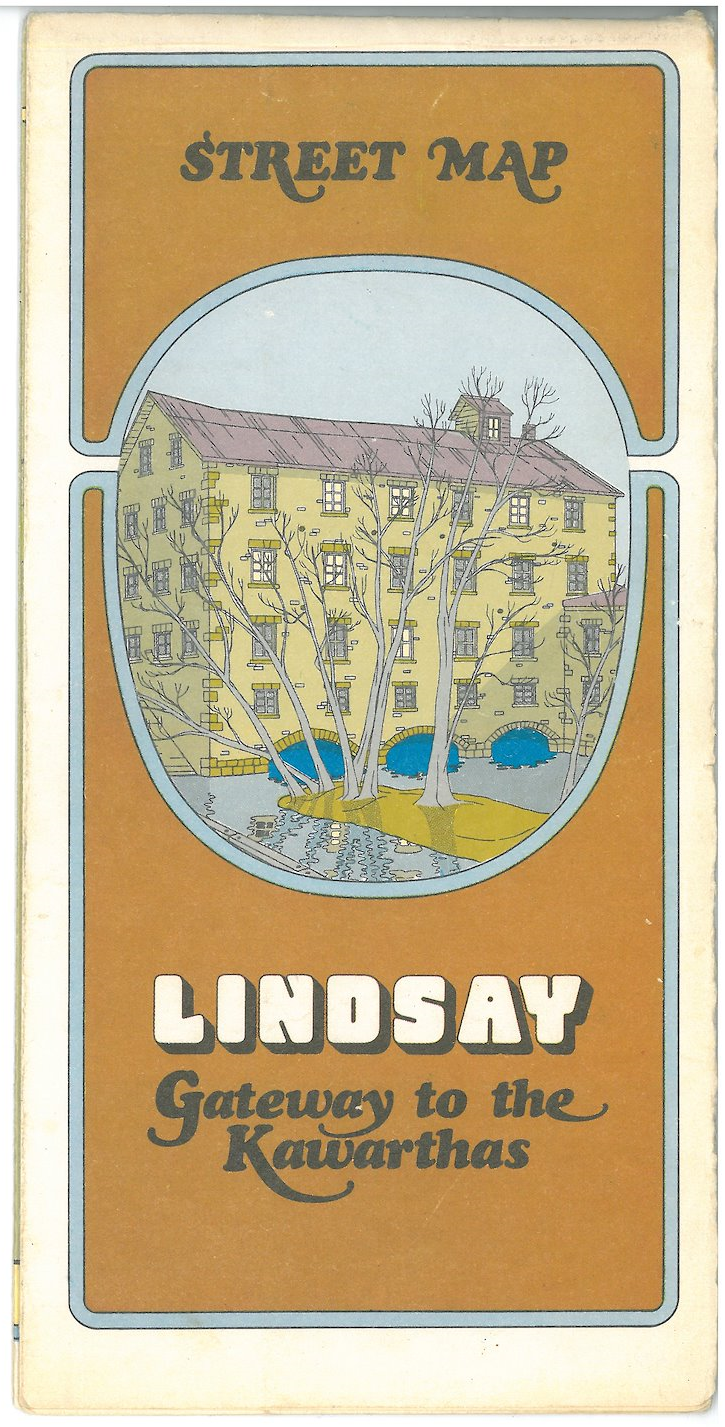
This brochure, dating to the 1970s, was produced by students of the Cartographic Technology Program at Sir Sandford Fleming College. On the cover is a stylized drawing of the Old Mill, as it appeared before a devastating fire in 1978. In the 1990s, the landscape around the Old Mill was being considered as a potential place for a combined art gallery and museum. Nothing came from this plan. Image courtesy Kawartha Lakes Museum & Archives, 2021.57.1.
In 1996, then-Mayor Martyn Stollar addressed a meeting of The Lindsay Gallery board in which he spoke about a report in the local paper about the possibility of the Old Mill site being redeveloped as an arts centre that could include the Gallery. According to minutes taken at this meeting, Stollar was "…hoping this project [would] proceed quickly."
And things seemed to move quickly, indeed. By 1997, both The Lindsay Gallery and the Victoria County Historical Society were engaged in conversation about opportunities for collaborating in some capacity at the Old Mill site. A 1998 master plan for the site included several conceptual designs, two of which proposed that a combined "Gallery/Museum Complex" be built adjacent to the ruins of the Old Mill. This would be complemented by terraced lawns, a fountain, a lookout, outdoor exhibition spaces, and plenty of trees.
Two years later, in 2000, a recommendation brought before Lindsay Town Council by the Parks and Recreation Department specifically requested that "the Council of the Town of Lindsay support, in principle, the concept of relocating the Leslie Frost Cottage and accessories from Pleasant Point to the Old Mill Park, Shaft Machine Park or other suitable Lindsay parkland, potentially for use by the Lindsay Gallery."
This passed unanimously but was never implemented. Today, a lovely park surrounds the ruins of the Old Mill, complete with a playground and ample green space – but nothing on the scale of what was proposed in 1998. Another dream had been dashed.
Going To Jail
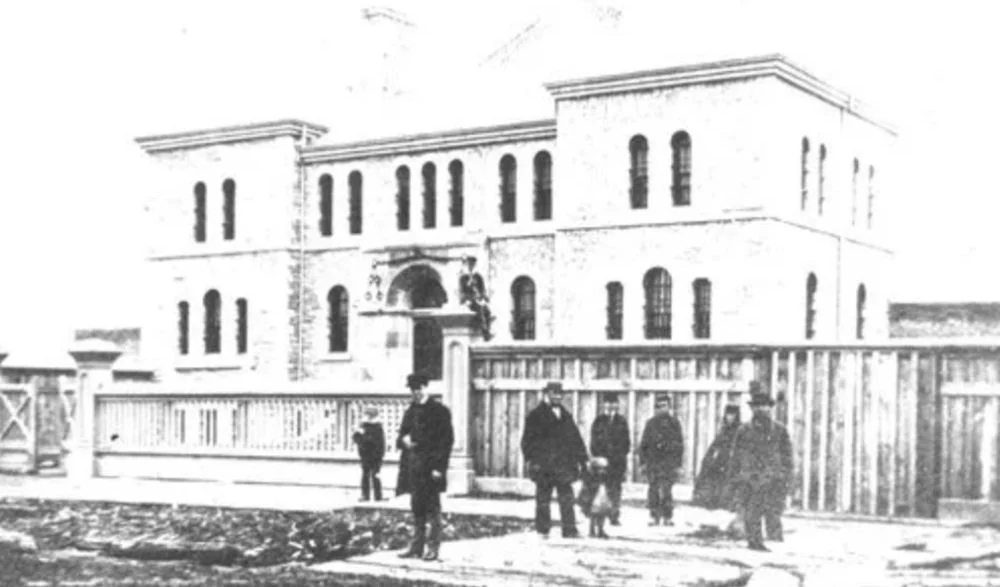
The Victoria County Gaol as it appeared in the mid-19th century. Built in 1863, it remained in continuous use until 2003, finally re-opening as a community museum in 2011. Discussions in the late 1990s between The Lindsay Gallery and the Victoria County Historical Society centered on the possibility of the two organizations sharing space in this venerable old building. Such a joint venture never came to fruition. Image: Public Domain.
While conversations about what to do with the Old Mill were playing out in the mid-1990s, another conversation was taking place in the boardroom of the Victoria County Historical Society. This conversation concerned the possibility of turning the old Victoria County Jail, which was soon slated for closure, into a community museum.
And a spirit of collaboration appears to have driven the conversation almost from the outset. (Minutes from a joint meeting of The Lindsay Gallery and the Victoria County Historical Society on November 18, 1997, reveal that there was discussion about the two organizations even sharing a curator should they share space at the Old Mill site.) The two groups decided to keep talking, and additional joint meetings were scheduled.
The Lindsay Gallery's Board of Governors met again on January 6, 1998. Minutes from this meeting confirm the intentions of both groups to formally collaborate (emphases added):
…Mill Site Design – It is Jim Thomson's belief that there is sincere interest by the Museum Board in co-operation with the Gallery to continue meeting jointly. The new Board of the Museum will meet in February following which time the Gallery will contact them to arrange further meetings. It was suggested that a list of concrete items be drawn up for discussion purposes.
Site for Gallery, etc. – Marjorie Porter reported that inquiries have been made to Victoria County Council regarding the use of the Lindsay Jail on Victoria Ave. for Gallery/Museum/Cultural purposes. Active lobbying should commence; with a joint effort from all interested groups, perhaps this could be accomplished. The need "to work together if we are to survive" was stressed…
By the end of 1999, the moniker "Heritage and Arts Centre" had emerged in communiques to describe the still-evolving plans for the old jail (which would remain in operation for another four years). The dream of a new home for both The Lindsay Gallery and the Victoria County Museum was seemingly on the verge of being realized, and internal memos from the Gallery – dated October 19 and November 1, 2000, respectively – reveal that sustaining a spirit of collaboration and cooperation was a priority (emphases added):
The matter before us has been talked about for nearly 3 years. The Gallery has been sincere it has to find a new home and it has on 2 or 3 occasions expressed interest in joining the Museum and/or other groups under one roof in a "Heritage and Arts Centre." The Gallery has also expressed casual interest in other sites but our financial position has been such that we have not been, nor are we now, in a position to make any monetary commitments until we would have a great many facts and figures to consider. The Historical Society has requested the "support of the potential participants in the new site." As "potential participants," the Gallery should in my opinion reaffirm our interest and support of the "Society's application for funds for a Strategic Plan." Further, we should agree to participation in meetings with the consultant. But the Society must bear in mind the impossibilities of our financial commitment, as mentioned above. (Memo, October 19, 2000)
Now that we have formally reaffirmed our interest in the old Jail site, I think there is an important next step, which is to begin to express some enthusiasm for the concept of a Heritage and Arts Centre. As "potential participants," the Gallery will have certain needs and requirements, and it is my firm belief that these will receive much kinder attention and consideration if we present ourselves as optimistic and amicable potential "partners" rather than as reluctant tenants. Of the two organizations, the Gallery and the Historical Society, the Gallery has the stronger Board so we need not feel intimidated. The two organizations belong, very naturally, under one roof. Let's not have it said down the road that the Gallery was the stumbling block to the success of a new Arts Centre for the new City. (Memo, November 1, 2000)
For various reasons, though, the two organizations ultimately chose to go their separate ways. In due time, the Victoria County Historical Society relocated to the decommissioned county jail, where after several years' worth of renovations and reorganization, it opened as the "Olde Gaol Museum" on May 24, 2011. In 2022, it rebranded as the "Kawartha Lakes Museum & Archives." The Lindsay Gallery, for its part, remained in the slightly truncated space on the second floor of the Lindsay Public Library once known as the Ethel Flavelle Gallery, and rebranded as the Kawartha Art Gallery in 2016.
What's Past Is Prologue?
In the years since, there have been various attempts to revisit the concept of a shared space serving the arts, culture, and heritage sectors in Lindsay. There have been feasibility studies and master plans, public meetings and even jointly organized events. Concerted efforts have been made to raise awareness among governments at all levels about the cultural, social, and economic importance of the arts.
Those conversations are ongoing.
But what can the long story of the Gallery's journey into a new home teach us today?
First, the arts, culture, and heritage sector has always lived precariously at the junction between long-term vision and short-term pragmatism. In a letter to the editor of the Lindsay Daily Post, dated June 6, 1994, Marion Laroque, a founding member of The Lindsay Gallery, offered the following recollection:
A number of supporters of Arts and Crafts will remember the late Charles Brett. Mr. Brett had a dream of turning the old charcoal factory on his property on the Scugog River north of Riveria Park at St. Paul Street, into a craft centre. Unfortunately the then town council claimed the property was within the railway zone and not on his property. Although the deed said otherwise the court ruled in favor of the town. The centre was never developed.
Like Charles Brett's dream, later efforts to reimagine the Shaft Machine Building and the Old Mill as cultural centres ran aground on the shoals of pragmatism. But the dreams persisted, and through the dedication and hard work of individuals and organizations things happened – albeit, sometimes on a smaller scale.
And here we should remember a very important point: might our impact as arts, culture, and heritage organizations be measured not so much by the size and grandeur of our spaces, but by the hearts and lives we touch in our community? Perhaps.
Second, collaboration remains citizen-driven. The Gallery is moving into a new home at 19 Cambridge Street thanks in no small part to the vision of Wesley Found, its owner, who has committed to honouring the legacy of his late father, Ken Found, through the arts.
This partnership is a shining example of what can be done when individuals and organizations with a common vision band together and make things happen. Collaboration is not something that can be enforced. It is not something that can be achieved merely by following a formula. Collaboration doesn't happen in a vacuum. Rather, it is grounded in the building of relationships, in the exchange of ideas, in the sharing of dreams.
That's what happened 50 years ago when The Lindsay Gallery first opened its doors. It's what happened nearly 70 years ago when what is now the Kawartha Lakes Museum & Archives got off the ground. And it's something that will continue to happen as long as this community continues to embrace the art in everyone.
Every month, join Research Associate Ian McKechnie as he opens the doors to Kawartha Art Gallery’s archives, sharing the remarkable history and the dedicated individuals who made the City of Kawartha Lakes only public Art Gallery with a Permanent Collection a reality.